
Key Takeaways
- Covenant compliance across a growing loan book holds up when every test reads from that loan's own agreement, in one cited record.
- The risk sits in the gap between portfolio system defaults and what each loan agreement says.
- One wrong default repeats on every loan it touches, so a small assumption becomes a book-level error.
- The data extracted at origination is the data you monitor for the life of the loan.
Real estate credit lenders are seeking any means of regaining time and capacity to keep up with their covenant compliance and portfolio monitoring needs in today's market.
A growing loan book requires more covenant testing against an expanding set of agreements. Often, credit teams are constrained by headcount or fragmented systems, causing slips when a T-12 needs to be re-keyed or a covenant test needs to be rebuilt by hand at quarter's end.
The question we hear from LPs, auditors, and borrowers is how you know a covenant result is right. A pass carries little weight if nobody can show which clause and which line of the T-12 produced it. By its nature, real estate credit makes that question harder to answer. In the U.S., the commercial real estate credit landscape has been growing steadily over the last decade as the asset class has further solidified its mainstream rank in institutional investment portfolios.
But this increase has an opacity tradeoff. Valuations are not conducted as often and therefore we have not seen a wide reset. That has basically created a value ledge for real estate lenders, who now lack the certainty to know if an asset's last appraisal is worth their time and debt if they are bidding to lend on it.
Lenders have been getting more creative in the current market. Bespoke solutions for every capital stack have been a defining factor in deal closings today. Each agreement defines its own covenant math, and portfolio transparency starts with knowing what each one says.
The Gap Between What the System Assumes and What the Loan Says
Portfolio systems run on defaults: one management fee rate, one reserve assumption, one way to build EBITDAR, applied to every loan. Every loan agreement is distinct, even if a lender is financing a familiar asset in a repeat sub-market. Each one sets its own terms for covenant testing.
A covenant test is only as good as its inputs. If the system deducts a fee the agreement doesn't specify, the DSCR it reports belongs to a loan you never wrote.
The definitions live in the credit agreement terms, so the test has to start there. The hard part is that a flat default looks reasonable. Once it sits in the system, nobody questions it.
What a Flat 5% Management Fee Hid in a Commercial Book
A lender working with Hypha, with several hundred commercial housing properties, found this gap in its own book.
One Assumption, Several Hundred Loans
The lender's legacy portfolio system deducted a flat 5% management fee from every loan. The agreements said something else. Some specified fees of 2.5–4%, and roughly 360 properties used "whichever is higher, actual or 5%."
Hypha read each covenant from that loan's own agreement and compared it with what the system applied. The gap showed up across the portfolio, loan by loan, with the clause behind every number.
The error ran in both directions. On the 2.5–4% loans, the flat rate deducted more than the agreement allows, so headroom looked thinner than it was. On the "higher of" loans, any operator paying above 5% got credit for EBITDAR the agreement doesn't permit.
This is how covenant compliance across a growing loan book breaks. One wrong default repeats on every loan it touches, and each new loan inherits it.
How a 1.05x Loan Reported as 1.28x
At one property, the operator pays a 7.0% management fee. Under the "higher of" clause, the covenant calculation should deduct the full 7.0%. The system deducted 5%, which overstated EBITDAR by about 22%.
That moved DSCR from a true 1.05x to a reported 1.28x. Against a 1.25x covenant, a fail showed up as a pass.
| Metric | Reported (flat 5%) | True (per agreement) |
|---|---|---|
| Management fee deducted | 5.0% | 7.0% |
| EBITDAR | Overstated by about 22% | Per agreement |
| DSCR | 1.28x | 1.05x |
| 1.25x covenant test | Pass | Fail |
It wasn't the only one. Other properties showed EBITDAR gaps of roughly 9%, 6%, and 4%. Each would reach committee looking clean, because the arithmetic was right and the input was wrong.
Catching a covenant calculation error before committee means checking each input against the agreement. A second pass on the formula finds nothing when the formula was never the problem.
What Reconciling the Book Changed
The reconciliation does more than reduce risk. Fee mismatches can mean money left on the table, so checking every agreement recovers value too.
With continuous covenant compliance, each new T-12 is tested against that loan's own agreement as it arrives. The next bad default gets flagged on the first loan, before it spreads to the rest of the book.
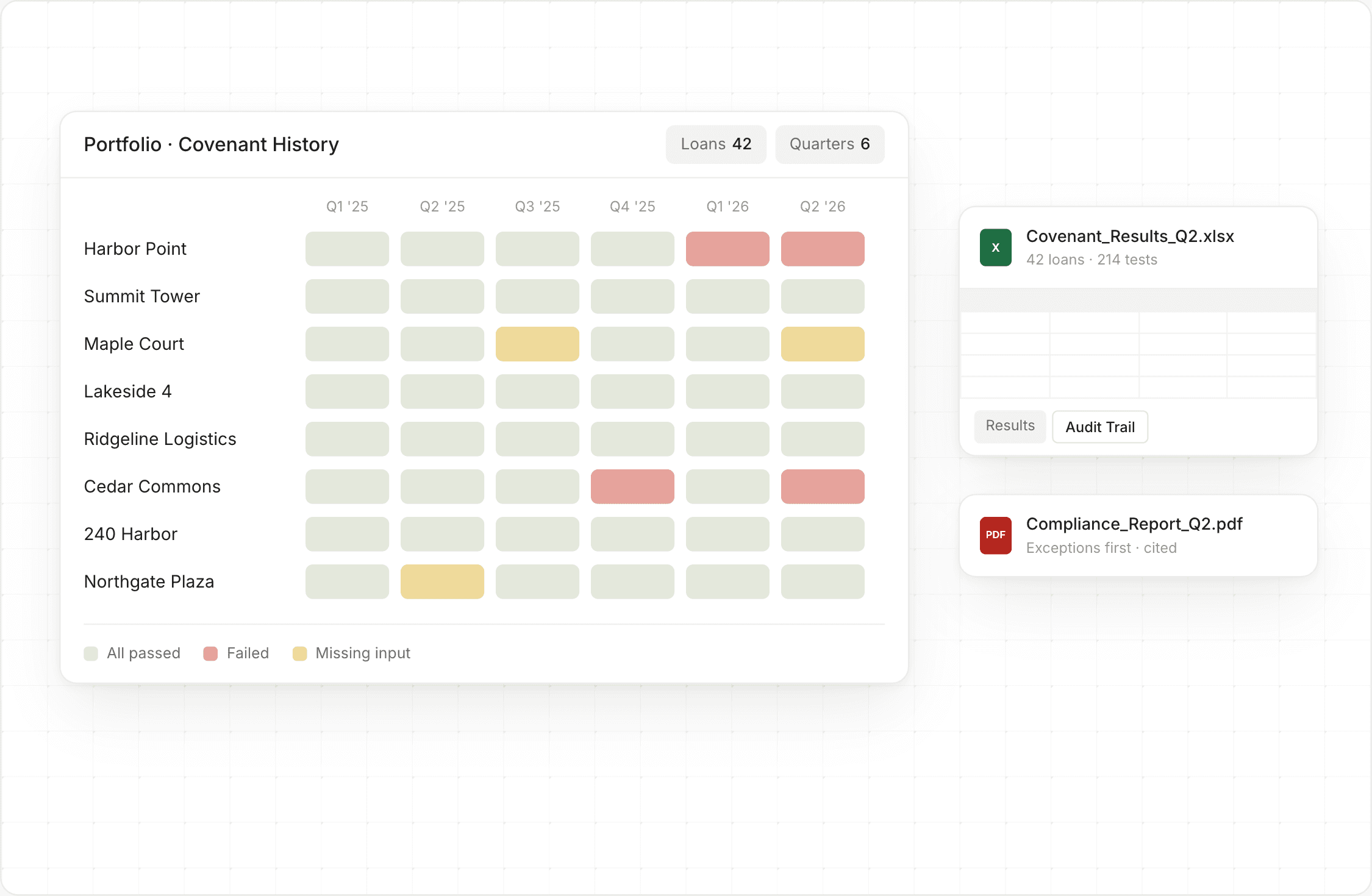
Traceable Numbers Answer the LP and Auditor Question
With Hypha, reading covenants from source documents makes every number traceable. When an LP, auditor, or committee asks why a loan passed, the answer is a clause and a line item, each with a citation. With source-traced financial spreading, every cell links back through its mapping decision to the source page. Review means following a trail, and nobody redoes the work.
It also removes duplicate work. When LP reporting and covenant compliance draw on sourced citations, the numbers in the quarterly letter match the numbers in the covenant test. That record is the single source of truth for the loan portfolio, built once and reused.
Every change is logged. Nothing reaches a committee without a named person approving it, and the log shows who approved, who overwrote, and which document each number came from. That is what an auditable loan review looks like.
In our experience, teams that wire this up with a general-purpose AI tool hit the wall at extraction. A model without domain context can't apply firm rules or cite sources across hundreds of loans, which is why general-purpose AI falls short for this work.
Transparency Starts at Origination
Committed capital sits on a deployment schedule, and the investment period doesn't pause while the underwriting queue catches up. The only responsible way to move faster is to see the whole book while you do it.
That visibility starts before the loan closes. The data extracted at underwriting is the data monitored for the life of the loan. The same deal record carries forward through screening, underwriting, and every covenant test, with nothing re-keyed.
Hypha supports origination with Deal Analyzer, which extracts every number from the OM, rent roll, and T-12 and cites each one to its source. Analysts stop re-typing financials and spend that time on credit calls.
Brandon Rosenblum, senior managing director and head of asset management at MonticelloAM, described the volume problem on the origination side.
"The only way to be able to execute against that large population of transactions is through the use of technology, data, automation, and efficiencies," he says.
The clock is short, too. "Sponsors want to understand what our initial feedback is on a transaction within 24 hours these days," Rosenblum says, "they want to see terms on a new transaction within a week."
His goal is to rank deals "red, yellow, green" from extracted data. That gets his team to "a quick no on a lot of the transactions that ultimately don't fit our needs and our box."
A quick no is only safe when the screen reads the documents correctly. The same extraction that sorts deals at the top of the funnel becomes the covenant baseline after close. The transparency that LPs and counterparties expect from real estate lenders starts with a firm's underwriting process. The managers and lenders who understand that are moving toward automation so portfolio-level reporting becomes a matter of technology and not additional headcount.
See How Lenders Approach Portfolio Transparency at Hypha's Inaugural Webinar Event
Portfolio transparency comes down to knowing what each loan says and being able to prove it. It starts at origination and holds only when every covenant test reads from the agreement.
On October 22 at 1PM ET, Hypha is hosting its inaugural webinar event wherein active lenders will walk through how they approach portfolio management.
Frequently Asked Questions
How Do Credit Teams Keep Up With Covenant Compliance Without Adding Headcount?
They test every covenant against that loan's own agreement from one cited record, so analysts stop re-keying T-12s and rebuilding tests each quarter. The team's time shifts to reviewing flagged loans and making credit calls.
How Do You Test Covenants Directly Against Credit Agreement Terms?
Extract the covenant definitions from each agreement, including fee rates, "higher of" clauses, and income and expense definitions, then apply them to that loan alone. Every result should cite the clause and the line item it came from.
How Do You Catch a Covenant Calculation Error Before Committee?
Check each input against the agreement, because a clean calculation on a default assumption still produces the wrong DSCR. When every input is cited to its source, that check is a quick review.
How Do Lenders Manage LP Reporting Alongside Covenant Compliance?
Run both from the same financial record, so the figures in LP reports match the figures in covenant tests. Logged approvals and citations then answer LP and auditor questions without a separate reconciliation.
How Do Lenders Build a Single Source of Truth Across a Loan Portfolio?
Extract and spread each borrower's documents once, at origination, and carry that same deal record through underwriting and monitoring. Every later update adds to that record, with each change versioned and tied to a named person.