The Model Isn’t the Moat:Asset Intelligence Is.
The frontier AI labs are of the most watched companies on earth. They’re extraordinary businesses that are indispensable to everyone, selling raw intelligence to anyone with a credit card.
But intelligence (at any given level) is quickly becoming a mere commodity. The clearest evidence for this is in the price itself — it’s collapsing. What cost $60 per million tokens in 2020 costs pennies today. Capabilities that were at the frontier 18 months ago are now nearly free, and open-source models keep closing the gap.
But what models’ commodified insights don’t offer is a definitive, competitive edge — especially for commercial real estate. Advantage now comes from how you put that raw material to work, building the right moat for your business. For investment teams, that is Asset Intelligence.
Asset Intelligence for Investment Teams
Think of your typical models (Claude, ChatGPT, Gemini, Grok) the way you would think about AWS, Azure, or Google Cloud. At the end of the day, nobody wins a deal because of who hosts their servers.
Our bet is that Asset Intelligence, not raw model intelligence, is where lasting advantage gets built. Asset Intelligence offers a current, connected view of every asset, so you can see risk earlier and grow your book with confidence.
Asset Intelligence
is a current, connected view of every asset that allows you to see risk earlier and grow your book with confidence.
Every fact a lender needs exists somewhere, whether it’s in a loan agreement, an appraisal, a rent roll, a T-12, an amendment, a spreadsheet, or an inbox. Nothing is missing, but nothing is visible, either.
The truth about billions of dollars of assets sits scattered across thousands of files. This means no firm ever holds a complete picture of its own risk. Instead, it understands only what made it into the underwriting model or the credit memo. These are snapshots, assembled by hand, which go stale the moment they’re completed.
The Cost of Not Knowing
Relying on isolated snapshots creates a distinct class of disaster: the existential loss that was hiding in plain sight right before it hit. If that sounds abstract, look at the last year alone.
Tricolor, a subprime auto lender, collapsed amid allegations that the same collateral had been pledged to multiple lenders at once — a fact that lived in documents, and that no single lender could perceive.
First Brands, an auto-parts giant, went bankrupt while creditors were still discovering billions in off-balance-sheet financing they didn’t know existed.
None of these were failures of intelligence. Smart, well-paid people sat on every side of those deals. They were failures of visibility. The risk was in the documents the whole time.
Model Intelligence Alone is Not Enough
A general-purpose model is trained once, on the general written record of the world. What it cannot learn is what things mean in specific places, in specific context. This isn’t a flaw in the models. It’s just what they are. How your firm reads census in senior housing, where your credit box actually draws its lines, which sponsors have been your best fit and why, what moved the pricing on that 2023 deal between the fourth and fifth term sheet: none of that was ever going to be in a model’s training data, and you wouldn’t hand it over if the labs asked. It’s your private data and your judgment.
A rent roll is a simple example. Models can read a spreadsheet, but they have a harder time understanding what it represents. It may cover one property or several. It may combine different time periods. The relevant information may be spread across tabs, with anomalies that need to be flagged, ignored, or pieced together.
The better the models get, the more valuable that asset context becomes. Every improvement in raw intelligence raises the return on the architecture around it.

How Hypha Builds Asset Intelligence
A loan package arrives as a pile of documents. Hypha turns that pile into a durable understanding of the asset itself. Every fact stays tied to its source. Every relationship (between documents, loans, sponsors, and portfolios) is encoded. The result is a shared record the team can review, update, and rely on over time.
Hypha’s knowledge layer draws on three kinds of data:
The private, non-financial record
The legal agreements binding the sponsor, the debt structure, the appraisals.
The Financials
Hypha normalizes incoming balance sheets and P&Ls into your structure, so every asset’s numbers arrive speaking your language.
Enrichment
The public and third-party data that completes the picture (think CMS clinical ratings, demographics at a three and seven-mile radius, market data for the asset class). Enrichment also covers connectors. So, a borrower’s email updates flow straight into the asset record instead of being copy-pasted into deal notes.
Context
In a loan package, a maturity date is not just a date. It appears in a loan agreement and belongs to a loan, which is secured by specific properties, which sit within a relationship with a sponsor, which sits inside a portfolio.
In our early benchmarks, general purpose AI models didn’t reliably get this. They’d confuse an address for a property, or misread what “beds” (i.e. occupancy) meant in senior housing.
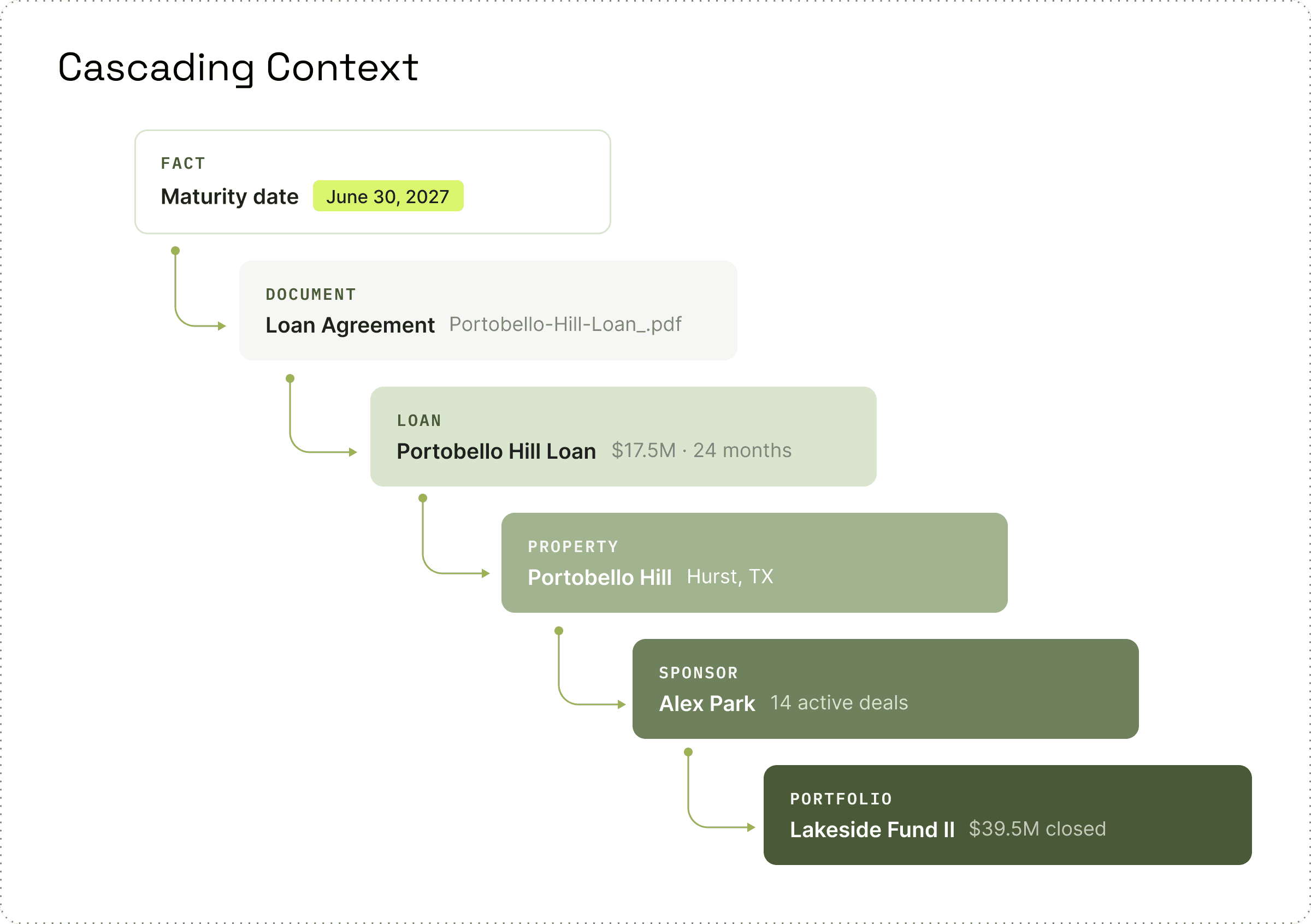
Hypha builds that context in from the start. Underneath the product sits a rich topology: a densely interconnected map of everything worth knowing about an asset.
Every attribute carries a definition (a bed is a unit of licensed capacity), extraction rules (bed count comes from the latest appraisal, and if it isn’t there, Hypha tells the model where to look next), and its place in the context chain.
Because everything in the topology is connected, you can start anywhere and follow the connections. This is what we call cascading context: every fact arrives with the whole chain attached, so the model produces answers a team can understand, verify, and use.
Collaboration
A deal moves across analysts, originators, asset managers, credit teams, and leadership. Each person needs to understand the asset from a slightly different angle, but they all need to be working from and refining the same underlying view.
That is hard to do when the work happens in separate spreadsheets or in private AI chats. A general-purpose model can help one person answer a question, but it does not create a shared place for the team to build and carry forward its understanding of the asset. Multiplayer lives in the architecture of our model.
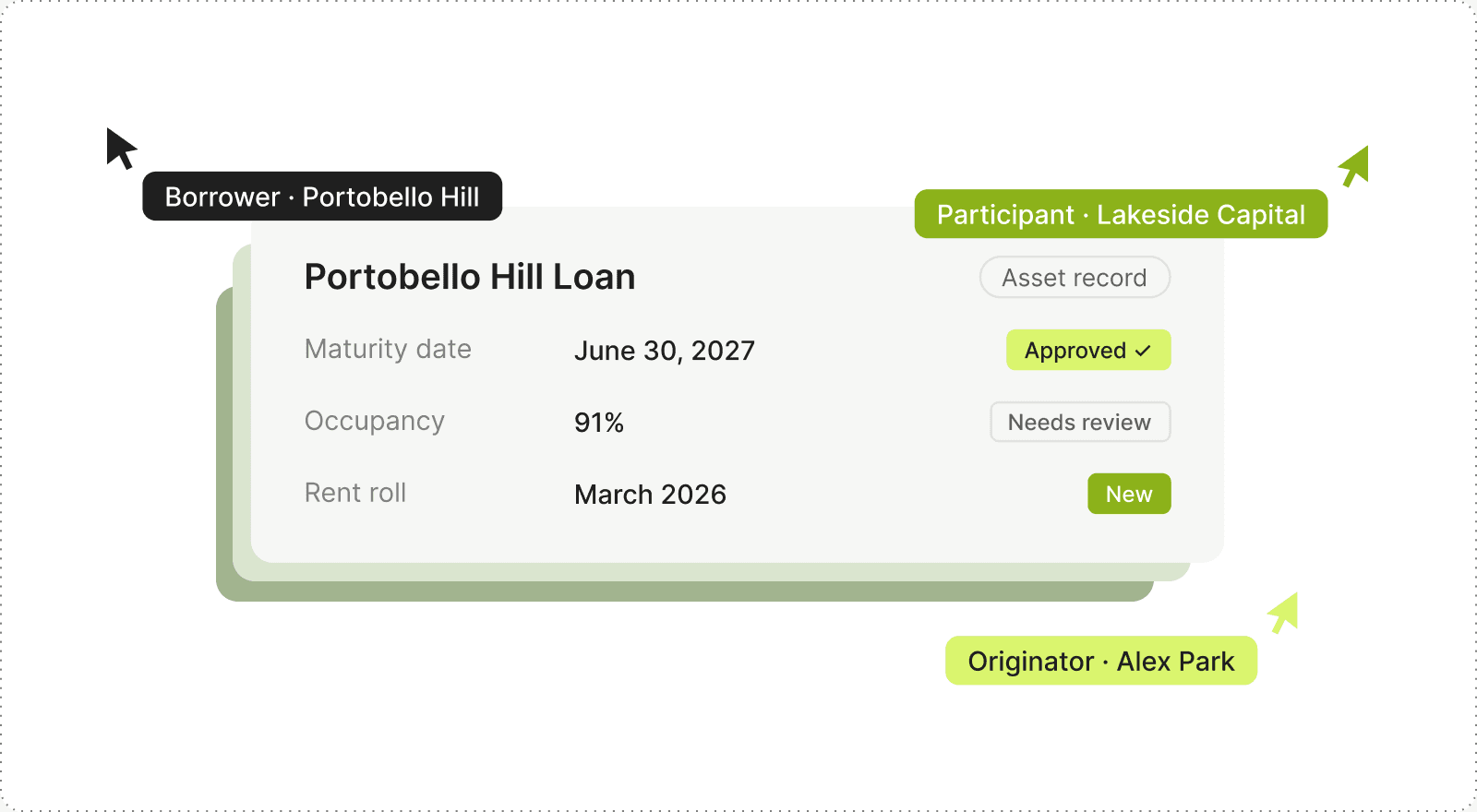
Hypha lets teams review the same facts, see the same supporting documents, approve or correct values, and keep those decisions attached to the asset as it moves from origination, to underwriting, to asset management.
That collaboration extends beyond the firm. Today, a borrower sends financials, the lender realizes some are late or incomplete, and the follow-up turns into another email or phone call. The same pattern holds between firms: when one firm originates a deal and others participate in it, reporting travels as PDFs are attached to emails. Hypha replaces both with a shared view of the process and the asset behind it. So, borrower, originator, and participants are looking at the same facts whenever they need them.
Audit Trail
None of that history can be edited — by anyone. Anyone who has prepared for an exam or answered to a regulator will know what that is worth. The audit trail also helps when the same fact appears in different places. Real loan packages often contain conflicting information, so Hypha can encode where a data point should come from first, and where to look next if it is not there.
For asset intelligence to be useful, teams need to be able to check the information is both accurate and complete. In Hypha, every value is tied back to its exact source, and every extraction carries signals that tell reviewers how closely to examine it before approval.

The history attached to an asset can never be edited — by anyone.
Hypha keeps that history attached to the asset, so the next person can understand both the current view and how the team got there. The how and the why stay with the asset long after the people who made those calls have moved on.
Portfolio Growth Relies on Risk Visibility
A covenant breach is a downstream signal. By the time it happens, your options for addressing it are few. Hypha moves risk awareness upstream. A covenant test only measures credit risk, and credit risk is the last to move — clinical, reputational, operational, and macro risk all shift first. Hypha pulls those warning signs out of the monthly financials, the occupancy trends, and the documents themselves (loan agreements, sponsor tax filings, and third-party reports such as appraisals and CMS clinical data). It surfaces them while the issue is still manageable.
Today, most firms see an asset in snapshots: one at origination, another at underwriting, another for each reporting period once the loan is on the books. Hypha replaces those snapshots with a longitudinal view. In a single query, you can assess the asset’s full performance history, along with every interaction and decision that shaped it.
That is the payoff of cascading context: asset intelligence brings clarity, clarity lets you anticipate risk, and anticipating risk unlocks growth. Not all growth is equal. There is the kind you take on confident it won’t blow up later, and the kind you chase and pay for. The firms in last year’s blowups weren’t short on capital or deal flow. What they lacked was exactly this: an understanding of where risk had been collected.
The Information Revolution is Coming to CRE
A generation ago, public equities went through a transformation in stages. First, information democratized. Bloomberg put the same data on every desk, and the edge from simply having the numbers disappeared. Then competition moved to analysis, and the quant shops won by modeling what everyone could now see. Then analyses themselves were commoditized, and the edge moved to speed (down to the microseconds of high-frequency trading).
Once again the edge of competition has shifted. Now, asset intelligence raises the bar on how firms compete and Hypha is your strategic advantage.
Commercial real estate has largely stayed opaque — for understandable reasons. The information has been genuinely harder to structure, but that’s no longer the case. A year from now, a lender looking at a property will have far more information, far sooner, and second-order effects will follow.
So every firm should be asking two questions: What is my moat today, and what will it be five years from now? Whatever the answer, it will rest on having the best asset intelligence in the room.
We named the company after the invisible network beneath a forest floor. We’re building that same kind of network of hyphae for commercial real estate. We are the connective layer every team needs to make the right decision about an asset.
A network is a necessity. Make sure yours is meeting the new bar.
Related reading
Commercial Real Estate Deal Screening Software
From deal documents to go/no-go in minutes, not days. Extracted, structured, and screened against your credit box.
Why General AI Isn't Built for How CRE Actually Works
See why general AI tools like Claude fall short for commercial real estate, and how purpose-built CRE AI delivers context, accuracy, and auditability.
Why AI Financial Spreading Needs Institutional Context
A solution architecture rooted in firm-specific context and productive human judgment.
Asset Intelligence from the ground up
Extract structured data from loan agreements, rent rolls, term sheets, and financials — human-verified and audit-ready.