
We spent the last several months building Financial Spreading at Hypha alongside CRE finance teams, sitting next to analysts and underwriters as they do their jobs, watching what their days actually look like, and figuring out which parts of the job AI genuinely helps with and which parts it quietly makes worse.
In this post, we explain why generalist AI fails to solve financial spreading at scale and what a purpose-built solution actually needs to do.
The challenge in financial spreading
At its core, spreading does two things: it maps each line item from the provider's operating statements to your firm's underwriting template, and it verifies the math. The first requires judgment. The second has a single correct answer. Most AI tools treat both as the same problem, and that's where things start to break.
Normalization is the biggest challenge to spreading. Every firm has its own way of categorizing line items and treating edge cases. These decisions accumulate over time and rarely live in a document. They reside in the head of the senior analyst who has been doing this for fifteen years, passed down through review comments and corrections.
This is where generalist AI tools like Claude hit a wall. They're powerful at getting you 60% of the way there on a clean document, and for teams doing this entirely manually, that feels like meaningful progress. But normalization requires firm-specific context that a generalist model has no way to access. It takes a greenfield approach every time, starting from scratch on every document and producing its best guess. From the analyst's seat, tracing why requires going all the way back to the source, manually isolating each step to find what was mapped incorrectly.
Every finance team has a spreading policy, written or not. Whether a self-managed sponsor's management fee belongs in property opex, G&A, or below the line entirely. Where R&M ends and capitalized repairs begin. Whether replacement reserves are deducted above the line or sit below NOI. Most of these decisions aren't documented anywhere. A system with no place to capture this can't get smarter at applying it.
Hypha's approach: building a single source of truth that compounds with every decision
Hypha built a Financial Spreading tool to solve the challenge of normalization. Not by replacing generalist AI, but by harnessing the power of it and building a context layer underneath that remembers your firm's judgment, learns from it, and makes it scalable across every document your team processes. Our approach contains three layers:
Layer 1: Document Extraction
Pulling structured data out of T-12s, rent rolls, OMs, and operating statements. Classifying rows and making sense of format.
Hypha owns this layer end-to-end like a generalist AI tool would. Real CRE documents are not clean or simple. Formats vary by asset class, sponsor, accounting system, and vintage. Doing this reliably across the full spectrum of what lenders and asset managers actually receive isn't a nice-to-have; it's the foundation the rest of the system runs on.
Layer 2: Business Logic Mapping
Decisions with one right answer, but only relative to your firm.
Hypha's agent proposes a mapping into your firm's chart of accounts for every extracted line item, grounded in the rules your team has already approved, prior patterns from this borrower, and the firm's standing policy on edge cases.
When the business logic mapping doesn't look correct, the correction is captured as a firm-level rule that auto-applies on future documents, so new analysts inherit the firm's collective judgment from day one instead of relearning it deal by deal.
Layer 3: Human Judgment & Continuous Mapping Refinement
Once auto-mapping is done, Hypha notifies the analyst to come in and approve the spread. We structure this review around three steps:
- Restatement check. Hypha surfaces deltas against historical filings so the analyst can distinguish a genuine restatement from a re-interpretation of the same source.
- Anomaly detection. Confirming that totals reconcile and subtotals tie to their line items.
- Manual adjustments. Human-judgment calls that don't belong in the firm's standing logic, such as a non-recurring legal settlement, or a sponsor-specific quirk that hasn't surfaced before.
Across all three, Hypha surfaces what the analyst needs to see and gets out of the way.
This is also where the system's learning extends beyond mapping. When a manual adjustment isn't actually one-off — when it reflects a firm policy the system hasn't captured yet — the Hypha agent picks up on the pattern and promotes it into a standing rule that applies automatically on the next spread. Over time, fewer adjustments need to be made by hand, because more of them have already been encoded as firm logic.
The Output
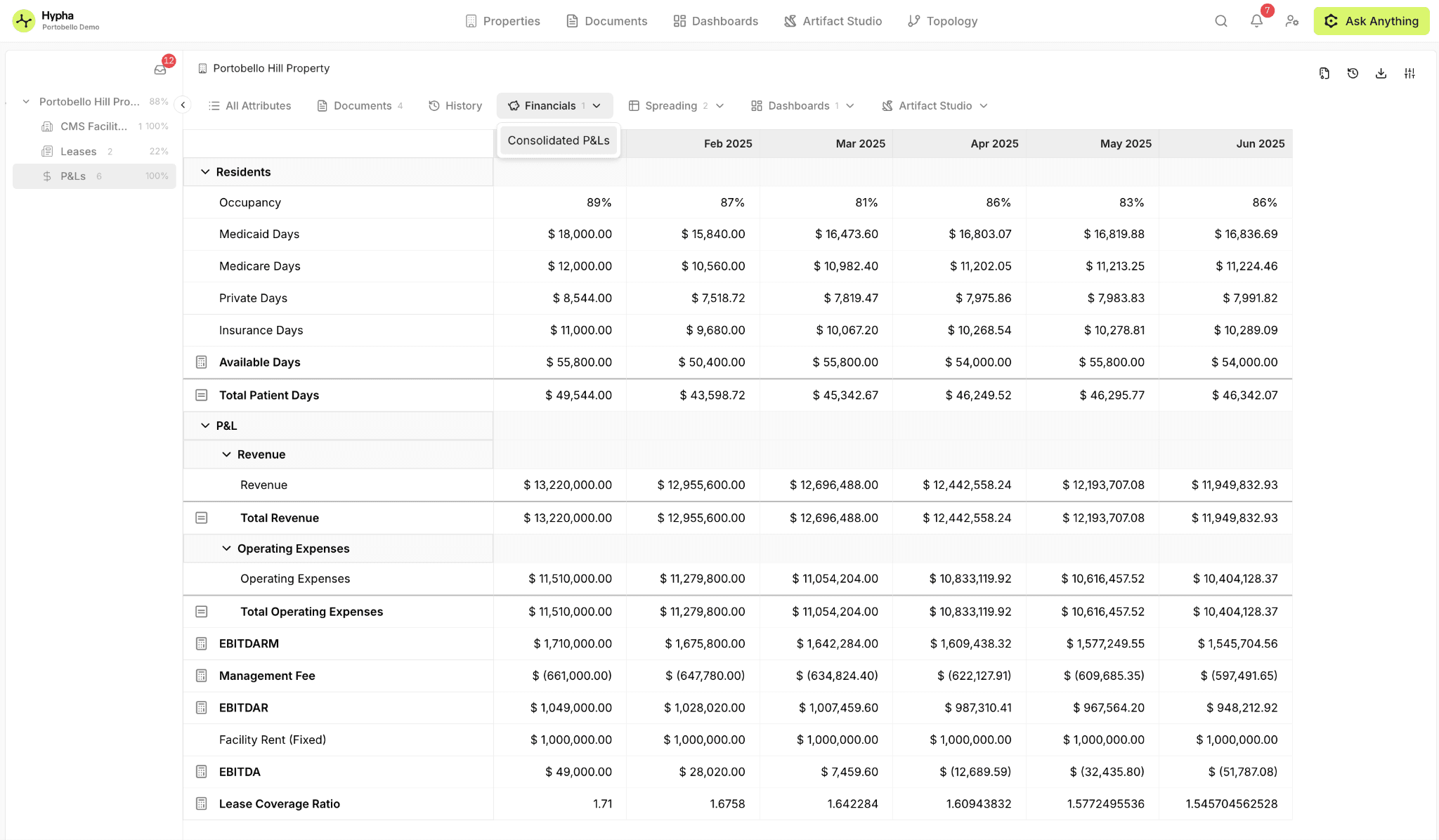
All financials are spread in the same environment, so once the process is done, the analyst gets a consolidated view in one place. The sheet is accessible and downloadable at any time.
The new standard for financial spreading
Spreading financials manually no longer has to be the norm. What replaces it will be systems where the analyst's judgment is the anchor, and the document mechanics are handled by agents operating against an auditable, versioned record of the firm's own decisions.
Here's what that looks like in practice for CRE teams using Hypha:
- One environment for the spread and the source. Your team can move between the spread and the underlying workbook without leaving Hypha. Hypha bridges that navigation gap between the "too general" and the "too detailed."
- A system that gets sharper the more financials spread. Your firm builds a shared reservoir of mapping logic that improves over time. Every adjustment an analyst makes becomes firm-level memory the agent applies to the next document automatically.
- An audit trail that holds up to scrutiny. You can trace any cell in the spread back through its mapping decision to the specific cell in the source it came from. No more compliance headaches.
What's next: Pro Forma
Spreading is the foundation. What we are building towards is a future where every forward-looking decision your firm makes is grounded in a single, reliable source of truth derived from every asset you've ever touched.
Transforming historical financial data into a Pro Forma Model is the next step that unlocks that: clean, normalized data feeding directly into forward-looking analysis that your business can act on as is.