
Private real estate credit is expanding its seniors housing presence as long-term residential solutions become even more critical for the stateside market’s aging population.
The continued rise of the seniors housing market into the institutional investing mainstream will not be without its headwinds.
Across the United States, sector occupancy currently sits at a post-2008 high and new construction is hard to come by. Existing assets need fresh capital to keep properties and operations intact. All the while, the most capitalized generation in the US is only growing older.
For private real estate credit managers, such as MONTICELLOAM, a New York-based manager focused on seniors housing, skilled nursing, and multifamily housing, this moment has presented a market share opportunity with plenty of noise to fight through.
The manager is helping set a blueprint for optimal seniors housing lending and using technology to further adapt its approach in the current market. Producing the highest quality of care, whether at an active adult community or skilled nursing facility, often steers the sector toward specialist lenders who understand the space and have a track record doing so.
Asset owners and operators across major seniors housing corridors — such as Florida, the New York Tri-state, and California — need fresh debt to keep their assets intact and talent in place.
Demographic forcing function
Akin to any other commercial asset class, speed and efficiency are paramount for lenders to operate at the peak of their capacity. But in the case of the seniors housing sector, that demand is also being pushed by America’s aging population.
The oldest cohort of baby boomers will turn 80 this year. That age threshold is often where many individuals and their families explore senior communities with an added layer of care or on-site medical personnel.
Data from NIC MAP placed seniors housing occupancy at 90.4 percent in the third quarter this year, the first reading above 90 percent since before the 2008 financial crisis. Q3 2026 marked the 21st consecutive quarterly gain and represented a 180-basis-point jump from Q3 2025. More than half of the trade group’s 31 primary markets now average 90 percent occupancy or better.
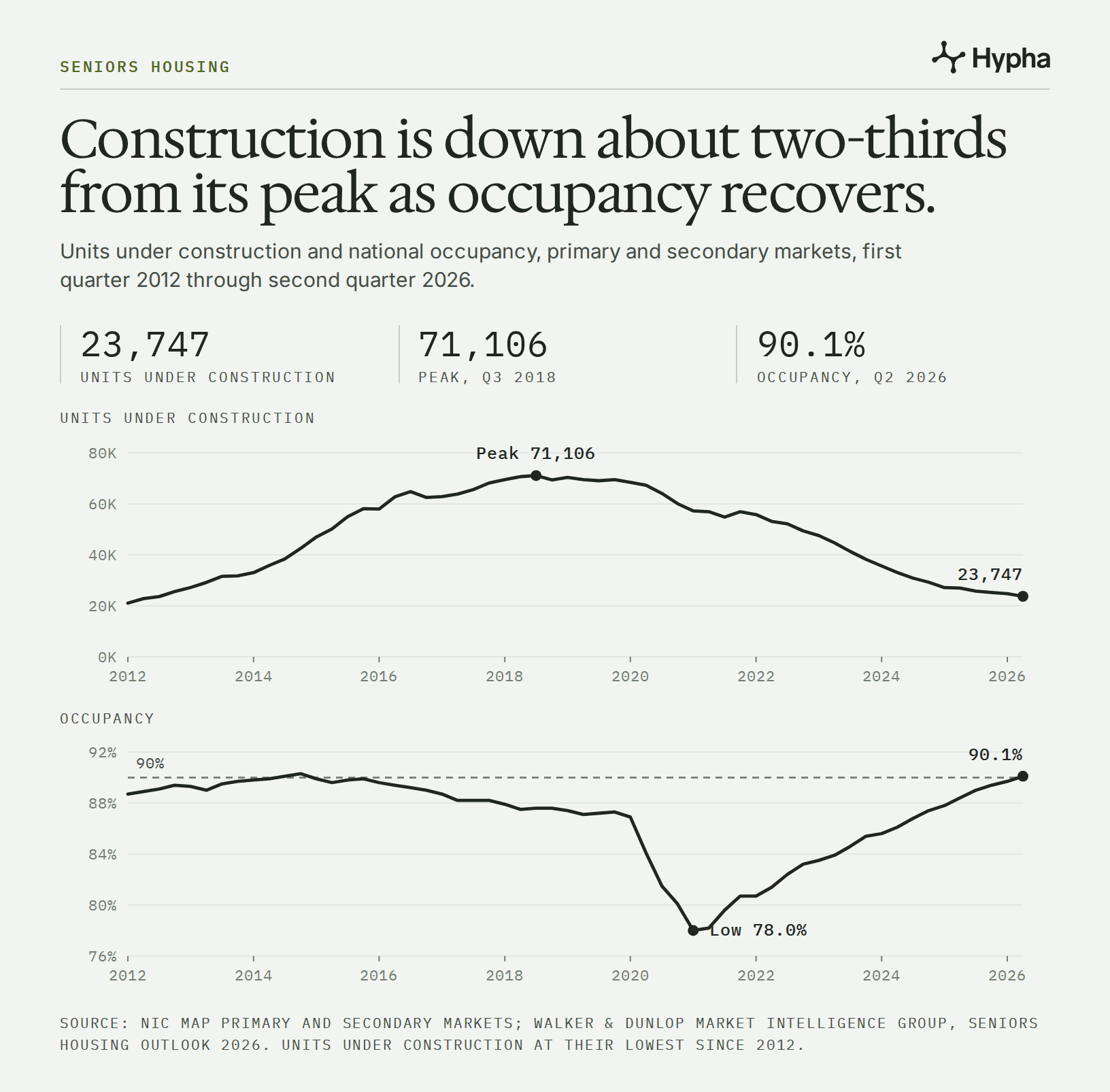
Seniors housing assets are not just a commodity in the current market, they are a necessity for elderly residents with fixed or disposable income that need more than a standard house or apartment can offer from an amenity, community, and care standpoint.
As MONTICELLOAM has seen firsthand as a lender, what keeps these buildings and communities open is invisible compared to the properties themselves. A steady flow of refinancing capital, debt for repositioning plans, and plain money to sustain operations.
All the above has come at a premium in the current market with some bank lenders still reserved on direct lending output and financiers generally hesitant to fund construction and new development where demand is not bursting at the seams.
Rising opportunity
Private real estate credit has been a solution to that gap. For a firm like MONTICELLOAM, more loan opportunities are arising from a confluence of factors.
“You’re seeing an aging population and really a lack of a lot of new supply,” said Brandon Rosenblum, a senior managing director and head of asset management at MONTICELLOAM, during Hypha’s Leverage webinar in October this year. “What that has led to at the end of the day is huge demand for seniors housing product, increased occupancies, and as a result, strong M&A activity.”
The demand curve is front and center too. By the end of this decade, every baby boomer will be 65 or older, and demographic experts expect the population aged 80 and over to double within 20 years.
Supply, however, is moving in the opposite direction. Holding occupancy at 90 percent as the population ages would take more than 100,000 new units to be delivered almost every year through the late 2030s. Compare that to the current development pace of 10,445 units a year.
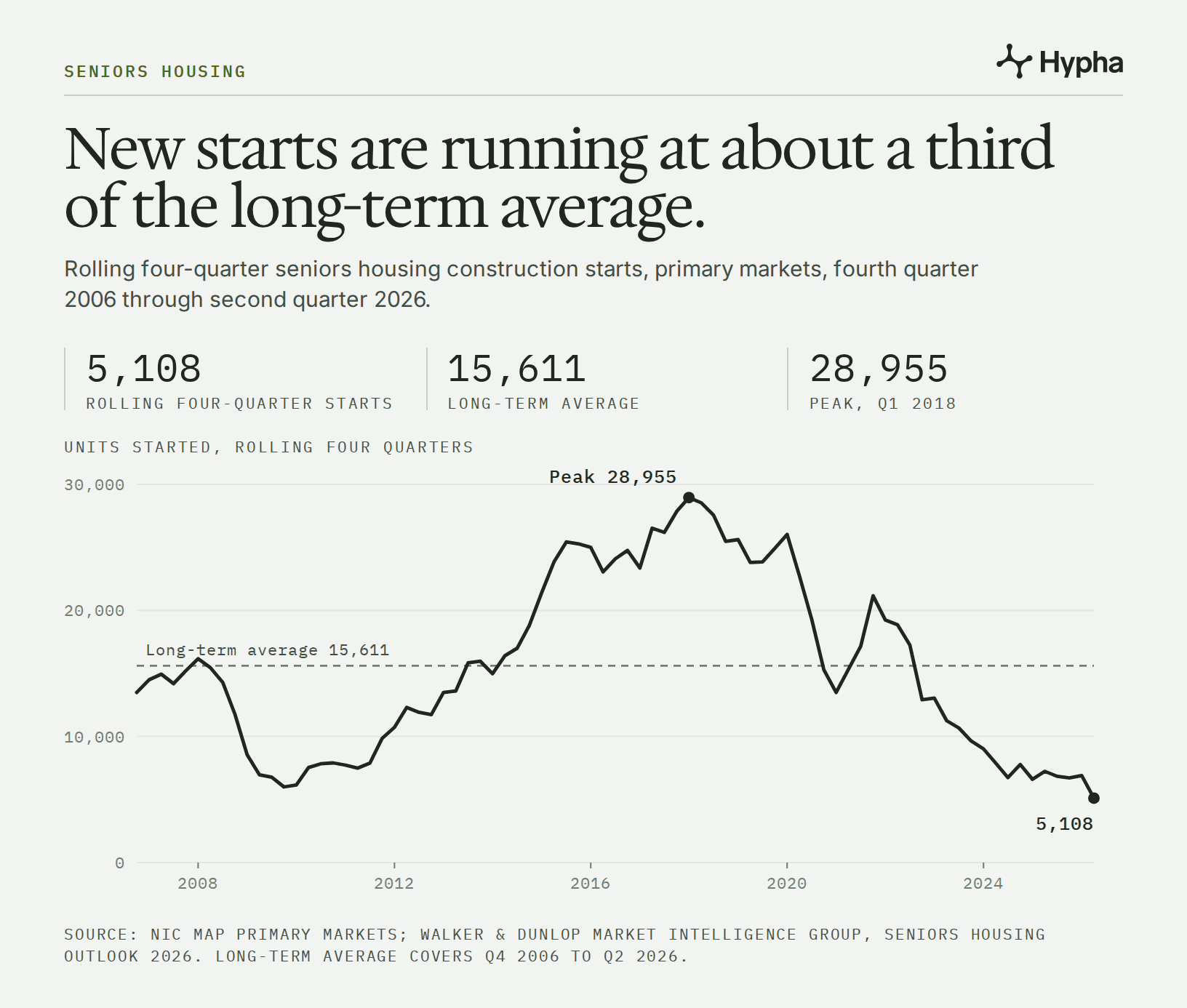
Fewer than 16,000 units were under construction at midyear 2026, and with construction cycles in the seniors housing sector averaging about 29 months, a project that breaks ground in early 2027 is unlikely to open before 2029.
Matching market speed
Capital is of course available, but every deal is conditional. The Federal Funds target rate range was held at 3.75% to 4% at the US central bank’s October meeting, and combined figures from MSCI and the Mortgage Bankers Association already mapped nearly $900 billion of commercial real estate debt due to mature during the 2026 calendar year.
Lenders are prioritizing asset quality, operator history, and stabilized cash flow to build the portfolios underscoring their debt books. For alternative lenders, including private real estate credit companies and debt fund managers, this presents selective windows of opportunity to expand.
Sponsors, though, want financing answers faster than many lenders are built to give. The bottleneck is rarely the credit decision itself. It is the work around it: offering memoranda, financial statements, and loan agreements that arrive as PDFs and have to become data before anyone can test a thesis or monitor a covenant.
MONTICELLOAM is one lender working through that problem in real time. Rosenblum says sponsors often expect initial feedback within 24 hours and terms within a week. “It’s not that they’re having unreasonable expectations, but that’s how the market is moving,” he said. “Otherwise, they’ll find somebody else who will.” The pressure shows up in the firm’s own book: about $2.3 billion of loans closed last year, more than $2.6 billion closed year-to-date at November’s start, and roughly $1.5 billion in underwriting.
Speed is not the only thing sponsors want from a lender. Visibility matters too, and Rosenblum sees it as part of how MONTICELLOAM competes. “Transparency is really key. I mean, sponsors and owners, they want to understand how they’re performing relative to the rest of the market, you know, relative to peers and sometimes relative to their own portfolios,” he said. “And so we have a lot of information to empower those users to understand their business as well as we do. And I think that’s a real differentiator for us and something that I think a lot of our sponsors appreciate.”
The firm’s answer has been to treat technology as a discipline on par with its sector expertise, applied across the shop and not confined to one desk.
Trusting the technology
“The only way to be able to execute against that large amount of transactions is through the use of technology, data automations, and efficiencies,” Rosenblum said. Several of the firm’s asset management and loan sizing processes are supported by Hypha.
On the front end, that means pulling data out of fragmented PDF reports and financial statements and bringing in comparable deals quickly, with the aim of ranking opportunities based on viability.
Much of what crosses MONTICELLOAM’s desk is not a fit, so a fast no matters as much as a fast yes especially when working with repeat and relationship business partners. Better technology at the start means more connectivity across the life cycle of every loan under that system.
Before asset management teams like MONTICELLOAM’s can monitor it to ensure the financials and operations of a seniors housing asset are as sound as the underwriting mapped them to be, the financing package has to be converted into usable data.
Terms, collateral, covenants, reporting obligations, bank accounts, post-closing items, repair requirements, extension options, and exceptions all need to live on a transparent record.
At MONTICELLOAM that once meant working through loan agreements, PCNAs, amendments, and bank account summaries by hand. A single package could clock in at 7,000 pages, 50 document types, and 2,500 discrete fields, with each field passing through an offshore first-pass review, asset manager validation and final sign-off.
A months-long process for a seniors housing market needing month-of capital commitments.
“We collect over a thousand data points on any transaction that we work on,” Rosenblum said. “It’s really important that we get data out of hard copy documents quickly and efficiently.”
Backing the rebuild
Adapting loan onboarding through one structured record changed the timeline for MONTICELLOAM. As of June this year, the firm has been running every new loan through Hypha. Loans that closed at the end of May reached final sign-off in under 10 days, expediting work that previously took months of Excel back-and-forth.

Each extracted attribute links to the page it came from, so offshore reviewers, stateside asset managers, and final approvers all operate from the same source. Originations for a critical housing market could then rise without adding back-office headcount alongside the deal flow.
Rosenblum says the same approach has similarly helped standardize income statements and balance sheets across transactions. The firm has data quality controls in place so that staff can focus on the items that require human involvement, such as speaking directly with a sponsor or borrower.
MONTICELLOAM re-evaluates each loan monthly and tests covenants quarterly, so the record gets constant use. That data repository is also leveraged for the firm’s investor relations team.
“We get investor requests for information and, you know, sometimes that information’s at our fingertips or sometimes there’s a more esoteric request that requires us to go back to all sorts of source documents,” Rosenblum said. “Viewing Hypha as the backbone of what we’re working on and indexing all of our various documents, you’re able to very quickly go back through those documents, pull out the relevant information, and provide more timely responses to clients. And some of those requests help us generate more investment management business for ourselves, so it’s very important.”
The next step is for the data to do more of the diagnosing. “One of the things that we’re working on right now is how could we feed information into our database, have the database tell us where the problems may lie,” Rosenblum said.
“For example, put in financials, understand that revenue is a problem. Well, why is revenue a problem? What is the specific data point that could be put back to a sponsor or operator to help understand why they’re having issues on the revenue side of their business?”
He expects that to end up in front of clients. “The way we kind of envision this working over time is we will be able to issue a 360-degree assessment to clients directly telling them here are the things within their portfolio that may be a challenge,” Rosenblum said, “and how do we use data and automation to do that versus having users spending the time doing that same work?”
The demand for capital to support seniors housing is only growing in the near term, requiring managers to adapt to keep pace. The pressures behind adapting today are shared across the sector: more residents than buildings, and sponsors who expect answers in days. Lenders that can fund quickly and still manage every loan closely will be better placed to keep these communities open.