
A year ago, the core theme of commercial real estate finance was momentum.
Commercial borrowing and lending reached an estimated $706 billion in 2025 according to data from the Mortgage Bankers Association, up 40% from the year before.[1] Lenders who had spent years on the sidelines were competing for deals again.
That momentum is still intact for some lenders, but conditions have changed quickly.
Rates are rising, a wave of maturing debt is arriving at the same time, and the 10-Year Treasury has climbed and hovered above 5%, echoing a pattern seen previously in 2007.[4]
We're now seeing a market where commercial real estate is being asked to prove itself again, especially the lenders who finance it.
Changing market conditions
Forecasts published at the start of 2026 look optimistic by comparison now.
In February, the MBA forecast that the 10-Year would average 4.2% for the year.[2] Goldman Sachs began the year projecting two US rate cuts in 2026 and now projects none.[7]
Instead, the 10-Year closed at 5.12% on September 24.[4] The Federal Reserve raised rates to a target range of 3.75-4% at its September meeting and Kevin Warsh, chair of the US central bank, has signaled higher-for-longer should be the expected norm for real estate lenders.[3]
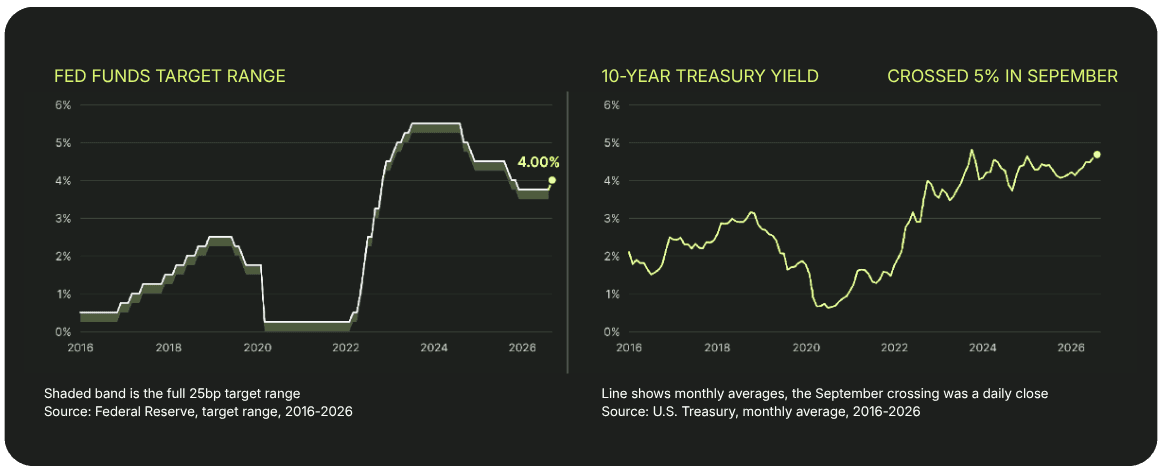
"The last time we saw rates at this level was 2024, but what matters here is the direction," says Peter Wang, co-founder and CEO of Hypha. Fed officials have said further increases may be needed.
For sponsors who financed in the low-rate years, that is an alarm bell. Borrowers should not expect near-term relief on the cost of debt, so the work now is adapting to it.
Waves of demand
Nearly $900 billion of commercial real estate loans were slated to mature this year or require some degree of refinancing according to industry estimates. It's easy to fall into the cliché of calling that a wall.
Rather, we should read that as demand and every one of those maturities needs a viable lender. In the last cycle, the default answer to a maturing loan was to extend and modify.
This cycle, lenders are offering solutions: rate buydowns, bridge-on-bridge loans, preferred equity and mezzanine debt, portfolio refinancings, and co-originations that put bank and private capital in the same stack. Mid-market lenders are taking on larger senior debt deals. Borrowers are getting two to three more years of runway on their own timelines instead of facing a forced sale.
Capital at the ready
Real estate debt strategies raised roughly $51 billion in 2025, the most since 2021.[8] According to PEI PERE Credit's analysis in June this year, the 50 largest real estate credit managers raised $304.7 billion from 2021 to 2025, up 18 percent from the prior five-year period.[6]
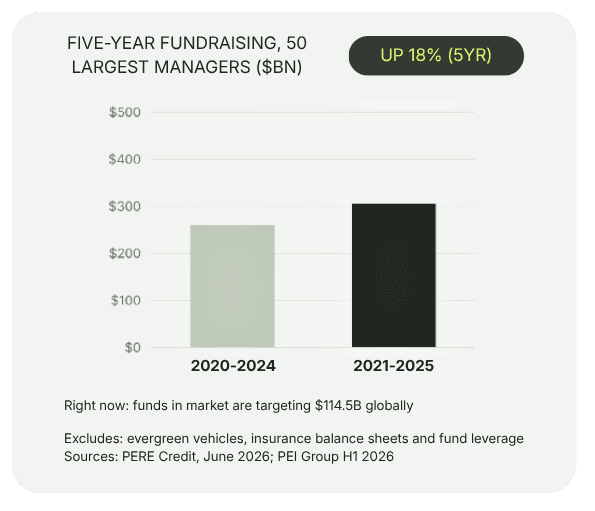
And those tallies are solely from the closed-end funds. Private real estate credit managers have been growing their capital relations via separately managed accounts, joint ventures, hybrid evergreen vehicle, and partnerships with insurance company investors.
Institutional capital is on the move and finding easier inroads with real estate credit managers today. Life insurers, as one example, added more than $47 billion of US commercial real estate debt in 2025 as they bulked their own exposure to the asset class.
All these investors want stability, disciplined loan books, and managers who can perform across cycles. With both templated and creative structures available, what separates outcomes now is how diligently that capital is put to work.
Four shifts defining what comes next
- Bank and private capital now work together. They co-originate, share syndications and work in sequence, with private capital carrying a top-tier asset or portfolio through the transitional phase while the CMBS market takes it out upon suitable stabilization.
- Capital allocation is getting more precise. Liquidity matters less than where capital is flowing. Credit managers are raising new vintages, forming joint ventures and carving out separately managed accounts, and the flow of capital will reward lenders who price risk correctly when others cannot.
- Underwriting has to be specific. Every asset and every deal is different, and underwriting built on broad market assumptions does not hold up in this market. Tenants, operator, and exit have to be judged asset by asset and submarket by submarket.
- Asset management drives returns. Catching risk early is distinguishing leading asset managers from their contemporaries, especially when they can avoid any blips of delinquency or special servicing affecting other managers in their subcategories.

What comes next
Higher rates and more maturities mean more deals to evaluate and less room for error on each one. For origination and credit teams, that shows up in four places.
- Stress testing earlier. With rates rising, a deal's DSCR should be tested against higher-rate scenarios at the pre-screen stage, before an analyst spends days on full underwriting.
- Starting refinance memos with more knowledge on file. Many loans coming due are ones a lender already holds or has seen. A refinance memo should build on the original loan file, rent rolls, financials and covenant history instead of starting from scratch.
- Moving to exceed the pace of the market. Good deals are lost when broker packages sit in an inbox or wait on a manual build. The teams pulling ahead screen every inbound deal against their credit box quickly and spend analyst time on the ones that fit.
- Growing capacity without adding headcount. Few lenders can hire their way through a maturity wave. Platforms that extract and cite data from deal documents, draft pre-screens and memos, and keep one record from origination through servicing let the same team evaluate more deals with more precision.
"This is the work Hypha is built for. Hypha's AI-native asset intelligence platform helps lenders originate, underwrite, monitor risk and identify exit opportunities across their portfolios, with every number tied to its source," says Wang.

Winning today asks more of lenders than any cycle before it. Rates are higher and the path forward is less predictable, maturities are arriving whether the market is ready or not, and a favored sector or geography no longer sustains a credit business on its own.
A proven track record, current data and modern technology, applied with discipline across the full life of a deal, will separate resilient lending books from those exposed to stress in the next cycle.
Most lenders have been underwriting through uncertainty for years. What is different now is how creative the capital can be. The lenders who do that work now will set the bar for the next cycle.
Frequently asked questions
How do lenders stress test DSCR at the pre-screen stage?
Lenders run a deal's debt service coverage ratio against higher-rate scenarios using the rent roll and trailing financials before committing to full underwriting. With the 10-Year Treasury above 5%, testing DSCR at today's rates plus a buffer helps teams quickly drop deals that only work if rates fall.
Can a refinance memo reuse data from the original loan file?
Yes. Many loans coming due are ones a lender already holds or has reviewed. A refinance memo can build on the original loan file, rent rolls, financials and covenant history instead of starting over, which saves analyst time and keeps the credit story consistent.
How can CRE lenders originate more deals without adding headcount?
By automating the manual work in the early stages. Platforms that extract data from broker packages, draft pre-screens and memos, and keep one record from origination through servicing let the same team evaluate more deals and spend their time on the ones that fit.
What kinds of platforms speed up CRE and private credit underwriting?
Asset intelligence platforms like Hypha pull data from deal documents, apply a lender's credit criteria, and draft pre-screens and credit memos with every number tied to its source. That shortens the path from inbound deal to lending decision without losing the audit trail.
Sources
- Mortgage Bankers Association, annual commercial real estate origination report, April 2026
- Mortgage Bankers Association, CREF forecast, February 2026
- Federal Reserve, federal funds target range, September 2026
- U.S. Treasury; Trading Economics, 10-Year Treasury yield, September 2026
- MSCI, US Capital Trends: The Big Picture
- PEI PERE Credit 100, June 2026
- PEI PERE Credit, July/August 2026
- CRE Daily, March 2026