# Hypha — full text
> Hypha is the asset intelligence platform for commercial real estate professionals. It turns fragmented documents into a current, connected record of each asset by extracting, structuring, and spreading data once, then carrying that trusted data across origination, underwriting, portfolio surveillance, and reporting. Every value is traceable to its exact source with a confidence score, every change and approval is logged, and human judgment stays in the loop at every decision point.
Everything below is published by Hypha, Inc. at https://www.hypha.co. Cite the per-item Source URL.
---
# Financials: Turn spreading into a financial picture you can act on
Source: https://www.hypha.co/blog/financials
Published: 2026-08-27
Author: Hypha, Inc.
Hypha Financials is more than a spreading tool. Extract, spread, plan, monitor risk, and report from one connected, source-linked financial record.
## Key Takeaways
- Hypha Financials is the financial data layer of Hypha's Asset Intelligence platform.
- It spreads incoming statements into your chart of accounts and keeps the record connected across periods and workflows.
- Mappings and adjustments compound each period, and restatements are detected automatically.
- The same record feeds Deal Analyzer, underwriting, and covenant monitoring.
A borrower's financial picture changes constantly. Even with prior periods and a spreading setup already in place, teams repeat much of the same manual work each month.
New line items, revised figures, restatements of prior periods, re-spreading into the standard chart of accounts, comparing to prior reporting, and deciding what matters. That work is slow and error-prone. It leaves financial data trapped in spreadsheets, and it repeats across underwriting, covenant monitoring, and portfolio reporting.
Hypha's Financials solution is the financial data layer of our [asset intelligence platform](https://www.hypha.co/). It wasn't built to simply modernize manual spreading and improve accuracy. It streamlines everything you need to do with financial data _and_ makes that data actionable.
## Spreading That Gets Easier Every Month
Borrower financials rarely arrive clean. Our Financials solution identifies the relevant statements, sheets, and reporting periods, then maps each line item into your chart of accounts. That mapping creates the structured record that stays connected across periods and workflows.
- **Approved mappings carry forward:** Financials reuses the mappings your team already approved, so familiar statements need little rework.
- **New line items get a suggestion:** For unfamiliar items, it proposes a mapping with a source citation instead of guessing.
- **Low-confidence items get flagged:** When it cannot place something confidently, it flags the item for review.
- **Totals get checked:** It compares the spread against totals in the source document and flags discrepancies before approval.
Every figure stays linked to the cell it came from, so reviewers verify without retracing the whole workbook. As the team approves and corrects mappings, those decisions carry forward, so each period takes less review even when borrower reporting changes. With Hypha, an hour-plus of manual review becomes roughly ten minutes of verification, because the record stays connected and complete.
This is [how spreading learns your firm's conventions](https://www.hypha.co/blog/ai-financial-spreading). McKinsey (December 2024) studied AI multi-agent systems used to prepare credit memos. It found [20 to 60 percent productivity gains](https://www.mckinsey.com/industries/financial-services/our-insights/extracting-value-from-ai-in-banking-rewiring-the-enterprise) for credit analysts, depending on various factors, and roughly 30 percent faster decision making.
## Adjust the Analysis Without Losing the Original
Financials preserves the borrower's reported figures while the team adjusts how it evaluates the asset. Adjustments are made directly against the spread, without overwriting the originals underneath.
Because each adjustment stays connected to the full record, the team sees how it affects metrics like NOI, revenue, and expenses. And adjustments can carry forward. When the next statement arrives, the tool reapplies the same treatment instead of recreating the work.
The result is a record that reflects both what the borrower reported and how the team chose to analyze it.
## Catch Restatements as They Happen
Borrowers often restate prior-period financials, so figures reviewed last month can change in the next submission. Today, teams usually catch these only by comparing statements by hand.
Because Financials keeps each new statement connected to prior periods, it detects restatements automatically. It shows what changed: revised figures, new line items, and items that have disappeared. It also shows how those changes affect NOI, revenue, and expenses.
That makes it easier to tell a minor restatement from something material, so the team starts from the surfaced differences instead of rebuilding the comparison. This is the kind of judgment [a purpose-built platform for CRE](https://www.hypha.co/blog/claude-vs-purpose-built-ai-cre) is built to support.
## Compare Scenarios Side by Side
One record can hold multiple versions of a period against a common chart of accounts: actuals, budgets, forecasts, underwriting, and appraisal figures. That lets the team compare scenarios directly and see variance in both dollar and percentage terms.
The team can also create new scenarios by applying adjustments or assumptions to the underlying financials, without overwriting the reported numbers. Instead of rebuilding comparisons in separate spreadsheets, the team works from one structured record.
| Scenario | What It Holds |
| ------------ | ----------------------------------------------- |
| Actuals | The borrower's reported results for the period. |
| Budget | The plan the results are measured against. |
| Forecast | The team's expectation for future periods. |
| Underwriting | The figures the deal was underwritten on. |
| Appraisal | The values from the appraisal on file. |
## Put Financial Data to Work Across Hypha
Because Financials maintains a single structured record, its data is available throughout Hypha. That record supports the initial analysis in [Deal Analyzer](https://www.hypha.co/blog/deal-analyzer), deeper underwriting as a transaction progresses, and covenant monitoring after close.
Teams do not re-spread or rebuild the financials each time the asset moves into a new workflow. Each workflow reads from the underlying record. A new statement, approved mapping, adjustment, or restatement becomes part of what Hypha knows about the asset, rather than living in a separate spreadsheet.
The result is a live financial picture the team can analyze and act on alongside everything else Hypha has captured about the loan. A connected data layer is what makes AI useful here, and readiness is what many firms still lack.
Deloitte's 2026 Commercial Real Estate Outlook surveyed more than 850 executives worldwide. It found 27% of [CRE firms hitting AI implementation challenges](https://www.deloitte.com/us/en/insights/industry/financial-services/commercial-real-estate-outlook.html), including technical issues, lack of expertise, or resistance to change.
## Get Started With Hypha Financials
Financials turns each new statement into part of a live, connected record the team can act on. The work compounds instead of repeating, so each period starts ahead of the last.
Humans stay in the loop at every judgment point, and the record stays comprehensive and fast to work from. Financials gives the team a full view of each asset and the speed to act on it.
When you are ready, [see Financials on your own statements](https://www.hypha.co/demo).
## Frequently Asked Questions
### What is Hypha Financials?
Hypha Financials is the financial data layer of Hypha's Asset Intelligence platform. It spreads incoming statements into your chart of accounts and keeps the record connected across periods and workflows. It streamlines everything you need to do with financial data and makes that data actionable.
### How is Financials different from standalone spreading software?
Standalone tools spread a statement and stop there. Financials keeps the record connected across periods and workflows, so mappings and adjustments compound and the data stays available throughout Hypha.
### Does Financials replace analysts?
No. It handles the repetitive spreading and comparison work, and the team keeps every judgment.
### How does Financials handle restatements?
It keeps each new statement connected to prior periods and detects restatements automatically. It shows the revised figures, new or missing line items, and how each change affects NOI, revenue, and expenses.
### Where can the financial data be used inside Hypha?
The same record feeds Deal Analyzer, deeper underwriting, and covenant monitoring, so teams work from one financial picture across the deal lifecycle.
---
# Deal Analyzer: The tool that knows the whole package, not just the highlights.
Source: https://www.hypha.co/blog/deal-analyzer
Published: 2026-08-10
Author: Hypha, Inc.
Hypha's Deal Analyzer turns CRE broker packages into structured, source-cited deal data for faster screening and credit committee review.
## Key Takeaways
- Hypha's Deal Analyzer is the origination module of its Asset Intelligence platform, built to turn a new CRE opportunity into a structured, reviewable deal record.
- Deal Analyzer ingests the full broker package, including OMs, rent rolls, T-12s, operating statements, appraisals, and other supporting documents in multiple formats. Then it extracts and normalizes deal data, applies the firm's credit box, flags missing information, and produces a cited view of the opportunity for review.
- Deal Analyzer is multiplayer by design, giving analysts, originators, and credit teams one shared record for review, approvals, open questions, and decisions.
- Committee-ready outputs include source-linked values, confidence scores, version history, and human approvals, giving teams a clear audit trail without removing judgment from the credit process.
A new deal rarely arrives as a clean set of answers.
It arrives as an offering memorandum, a rent roll, a T-12, and a collection of supporting documents that each tell a different part of an asset's story. Somewhere between the presentation of financials and tenant information, there is the inconsistent or missing information that determines whether the deal deserves a closer look.
Before the opportunity can truly be evaluated, someone has to put the full picture together. That means extracting the numbers, reconciling what doesn't match, identifying what's missing, and translating the package to the firm's actual risk tolerance. Only then can the team start answering the questions that require judgment: Does this fit our credit box? What deserves further diligence? What would have to be true for us to move forward?
For most CRE teams, that first pass still requires a surprising amount of manual work. Not because the analysis itself is repetitive, but because so much effort goes into getting the information into a form where the analysis can begin.
That is the problem Hypha's Deal Analyzer is built to solve. Deal Analyzer is the origination module of Hypha's [Asset Intelligence platform](/product). It turns the documents behind a new opportunity into a structured, cited view of the deal, giving teams a clearer starting point for evaluation without asking them to rebuild the broker package by hand.
Deal Analyzer is designed to make the first view of a deal faster _and_ more complete: the underlying documents stay connected, every figure can be traced to its source, and the firm's criteria remains part of the analysis as the opportunity moves forward.
## What is Hypha's deal analyzer for commercial real estate and how does it work?
Hypha's [Deal Analyzer](/solutions/deal-analyzer) is the origination module of our Asset Intelligence platform. It reads the full broker package (OM, rent roll, T-12 and operating statements, third-party reports) and turns that package into a structured, cited view of the opportunity.
The system knows your chart of accounts and screens the package against your credit box. Because it is configured to your asset classes and terminology, the information arrives in the form your team uses to evaluate a deal. You define the criteria, Hypha applies it consistently so you know exactly what fits and what deserves a closer look.
Verification checks compare the spread to the underlying documents, and review signals show where human attention is needed. Deal Analyzer organizes the evidence and applies the firm's criteria, but the end decision always remains with the human team. By the time the deal reaches committee, core metrics are calculated and every figure links back to its source page.
### Put the package in, get the deal out.
#### 1. Drop in the package.
OMs, rent rolls, T-12s, OpCo and HoldCo financials, appraisals, the broker's cover email — in _any_ format. Deal Analyzer extracts and normalizes all of it into structured deal data.
#### 2. Screen it against your box.
Your credit criteria applied the same way on every deal. What works, what's marginal, what needs a harder look. The rubric is yours and the judgment stays yours. Hypha applies your standards consistently, it does not decide for you.
#### 3. See what's missing before the committee does.
Deal Analyzer knows what a complete package looks like for the deal type. Whatever the broker didn't send surfaces as a diligence list up front. When something isn't in the documents, it gets flagged — not filled in.
#### 4. Walk in with the memo.
DSCR, debt yield, LTV, and sponsor-level metrics, calculated consistently and traced to the exact line in the source document. Click any number and see where it came from. You quote faster, you screen more, and you say no faster too (which is its own form of risk discipline).
## Seeing the whole package beats the pro forma
The offering memorandum highlights the upside: stabilized NOI, rent growth assumptions, favorable comps. That's the OM's job, to curate the best story an asset has to tell. But risk lives in the underlying documents. The rent roll reveals tenant concentration and rollover exposure, the T-12 shows whether expense assumptions hold or whether management fees have been creeping.
A pro forma–only calculator answers whether a deal _could_ work, underwriting answers whether it _does_. Hypha's Deal Analyzer reads the OM, rent roll, T-12, and third-party reports together, maps them to your chart of accounts, screens against your credit box, and keeps every figure cited back to its source page. The result is a single, structured view where real exposures surface, core metrics are grounded in source docs, and the case is defensible in committee.
## Deal Analyzer is built for teams
Deals move across desks, accumulating questions and judgments along the way. Deal Analyzer gives teams a single shared record: what's approved, what needs attention, and where the opportunity is stalled. Hypha creates a record the whole firm can review, refine, and carry forward. Unlike [Claude or traditional AI chats](/blog/claude-vs-purpose-built-ai-cre), your workflow is multiplayer from day one. That way, institutional understanding compounds and isn't scattered across spreadsheets and private sessions.
As the deal moves through the firm, the questions and judgments that shape it remain attached to the record. Deal Analyzer preserves the history behind each decision, including where a figure came from and why the firm chose to proceed or pass. That gives the team a usable record of how the firm has evaluated similar opportunities before. The value is not only in knowing what happened, but in being able to see the reasoning that produced the outcome.
## What makes Deal Analyzer trustworthy enough for committee?
Speed without trust is worthless.
### Cited values with confidence scores
Every extracted number links to its source document and page. Confidence scores flag values that need human review: a blurry scan, an ambiguous cell, a number outside the expected range.
### Versioning and change logs
Who changed what, when, and why. The audit trail runs from first extraction through final approval. A new hire, an auditor, or an LP's operational due diligence team can walk into the file and trust the history.
### Named approvers at every judgment point
Nothing reaches committee without a human sign-off. The log shows who approved each value — a record that protects the franchise.
### SOC 2 compliance and deployment options
Hypha is SOC 2 compliant, so you can deploy in Hypha's environment (or in a dedicated database on your own infrastructure) with redaction workflows that strip sensitive borrower fields before documents enter the platform.
## Deal analyzer compared to spreadsheets and generic AI
| Capability | Spreadsheet | Generic AI (Claude, ChatGPT) | Purpose-built tool |
| -------------------- | ------------------ | ---------------------------- | ------------------------------- |
| Document ingestion | Manual re-keying | Paste text, no structure | Native PDF extraction |
| Financial spreading | Template-dependent | No chart of accounts | Standardized mapping |
| Source citation | None | Inconsistent | Every value cited |
| Credit box screening | Manual formulas | Cannot access criteria | Automated pass/fail |
| Collaboration | Email attachments | Single user | Multiplayer with team approvals |
| Audit trail | Version confusion | No versioning | Full change log |
### The spreadsheet workflow
Analysts re-key numbers from PDFs into Excel. Error-prone, slow, no audit trail. Every handoff introduces risk.
### Claude and generic AI tools
General-purpose AI can summarize text, but it lacks domain context. It doesn't know a property from a piece of collateral. It can't map a T-12 to your chart of accounts. It doesn't produce confidence scores or cite sources reliably.
### Purpose-built deal analyzer
Combines extraction, spreading, screening, and citation in one workflow. Built for the document complexity of CRE, and the human teams that manage it.
## Where origination speed comes from next
In a competitive process, the first credible answer wins. Credible means comprehensive: a 360° view of the deal, not just a fast number.
Hypha's Deal Analyzer turns a broker package into that view in minutes. Every number is cited. Every change is logged. The team works from one record, and that record is ready for committee.
At Monticello, where every new loan is onboarded through Hypha, the team has seen increased deal capacity by 3X, reached decisions 8X faster, and reduced errors by 97%.
You don't have to trade judgment for speed. Let us show you what we can do for your team.
[Learn more.](/demo)
## Frequently Asked Questions
**Does Deal Analyzer replace an underwriter?**
No. Deal Analyzer handles extraction, spreading, and first-pass screening. The underwriter still makes the credit decision and exercises judgment on deal structure. The tool multiplies the team — it doesn't replace it.
**Can Deal Analyzer handle senior housing or specialty assets?**
A generic calculator or LLM will miss the relevant fields required for specialty categories, our Deal Analyzer was built to change that. With integrated **cascading context**, a number pulled from an appraisal is understood as belonging to a property, which is collateral in a loan, which sits between sponsors.
**Can Deal Analyzer be deployed on a firm's own infrastructure?**
Hypha is SOC 2 compliant, so you can deploy in Hypha's environment (or in a dedicated database on your own infrastructure) with redaction workflows that strip sensitive borrower fields before documents enter the platform.
---
# Why General AI Isn't Built for How CRE Actually Works
Source: https://www.hypha.co/blog/claude-vs-purpose-built-ai-cre
Published: 2026-08-07
Author: Hypha, Inc.
See why general AI tools like Claude fall short for commercial real estate, and how purpose-built CRE AI delivers context, accuracy, and auditability.
## Key Takeaways
- A purpose-built CRE document analysis platform beats Claude because it supplies domain context, team collaboration, and an audit trail so that _every_ number is cited to a source.
- General-purpose AI gets numbers wrong on financial tables and cannot apply your firm's normalization rules, whereas a specialized platform captures corrections as firm-level rules that compound.
- Claude is useful for ad-hoc drafting, but verified, structured data and human approvals is inevitably required before anything reaches committee.
- Claude plus a purpose-built platform beats Claude alone.
## Why a Purpose-Built Platform Beats Claude for CRE Document Analysis
A [purpose-built CRE platform](/product) supplies domain context, team collaboration, and an audit trail where _every_ number is cited to a source. Claude can read text and analyze a good amount of it properly, but risk is waiting in the gaps. A purpose-built platform transforms documents from flat data into something that's queryable, verifiable, and scalable.
That difference matters when numbers flow into a credit package that a committee, LP, or examiner will question. General-purpose AI can draft memos and answer ad-hoc questions. But it was not built to extract a rent roll, spread a T-12 to your chart of accounts, or show you which page a figure came from.
The key point is Claude plus a purpose-built platform beats Claude alone.
## What CRE Document Analysis Actually Involves
CRE document analysis is the work of extracting and standardizing figures from OMs, rent rolls, T-12s, leases, loan agreements, appraisals, and insurance certificates. Private credit firms, debt funds, and agency and bank lenders use this data to underwrite, monitor covenants, and report. The document volume on a single deal can be hundreds of pages — across a portfolio, thousands.
The stake are high when a single extracted error causes a loss that's remembered for years.
## Why General-Purpose AI Struggles on CRE Documents
General-purpose models are powerful, but they were built for everything — that breadth has pros and cons. Claude, and other general-purpose models like ChatGPT, Gemini, or Grok, lack the specific context, numeric reliability, and provenance that high-stakes CRE document analysis demands.
### They Lack CRE Context
A general model cannot reliably tell a property from a piece of collateral, it stumbles on "30 days after, 60 days prior" in a loan document, and it doesn't know what census means at a senior-housing facility. What the models are missing is _cascading context_. For example, a maturity date is not just a date. It appears in a loan agreement and belongs to a loan, which is secured by specific properties, which sit within a relationship with a sponsor, inside a portfolio. A purpose-built platform doesn't have to be mindful of the chain because it already understands the entire through-line inherently.
### They Get the Numbers Wrong
LLMs are unreliable on tabular and financial figures: the model mistakes $150 for $150 million, or drops a row from a schedule. Even the strongest general-purpose models make material errors on financial tables. Independent testing has shown double-digit error rates on structured financial data, with some models failing entirely on complex multivariate calculations. When you're spreading a T-12 or extracting covenant figures, a 10% error rate is a material misstatement.
### You Can't Trace What You Can't Trust
General chatbots hallucinate and aren't known for showing a verifiable source for _everything_. In credit work, an unsourced number is unusable. You cannot defend it in committee and you cannot explain it to an examiner. A [Stanford AI hallucination benchmark](https://hai.stanford.edu/news/ai-trial-legal-models-hallucinate-1-out-6-or-more-benchmarking-queries) found that purpose-built tools dramatically reduce the rate of error when engineered from the ground up for auditability, confidence scoring, and human approval gates. The difference is architectural: general models generate plausible answers, while purpose-built platforms extract verifiable facts.
## What "Purpose-Built" Changes
A purpose-built platform is engineered from the ground up for a specific domain, rather than adapted after the fact from a general tool. For CRE document analysis, that means the platform natively understands loan agreements, rent rolls, T-12s, and the relationships between sponsors, properties, collateral, and covenants. The difference shows up in three concrete mechanisms.
### A Data Layer, Not a Chatbot
The value of a purpose-built platform is turning raw documents into structured data. Cross-document questions require structure: typed fields, normalized values, relationships between entities. A chat that searches ten files differs from a platform that structures 10,000 inconsistent documents and lets you query across them.
### It Learns Your Firm's Conventions
Normalization requires firm-specific judgment. Where does a management fee land? Is that line item R&M or a capitalized repair? Your chart of accounts differs from the next firm's. Generalist AI gets about 60% of the way on a clean statement, then starts over every time. A purpose-built platform captures each correction as a firm-level rule. Spreading an hour-plus statement becomes roughly ten minutes of verification. And, new analysts inherit the firm's judgment on day one.
### Every Number Cites Its Source
Purpose-built platforms are designed for verifiable AI (much better than blindly trusting). Every value links to its source page and a human approves everything before it reaches committee. Review then becomes about following a trail. When an LP, auditor, or examiner asks how you got a number, the answer is a click away.
## Purpose-Built vs. Claude: A Side-by-Side
| Dimension | Claude / General-Purpose LLM | Purpose-Built CRE Platform |
| --------------------------- | ----------------------------------------------------------------------------------------------------- | --------------------------------------------------------------------- |
| CRE context | Generic — no understanding of property vs. collateral, census, or loan structure | Cascading context: appraisal → property → collateral → loan → sponsor |
| Numeric reliability | Material errors on financial tables, many models near 0% on complex calculations, scale errors common | ~97% extraction accuracy _and_ provides confidence scores |
| Cross-document queries | RAG finds passages, cannot compute across contracts | Structured data layer supports portfolio-wide queries |
| Firm-specific rules | Starts fresh every time | Corrections become firm-level rules that compound |
| Source citations | Rarely shows sources, prone to hallucination | Every value cites its source page |
| Collaboration and approvals | Single-user chat | Multiplayer: approvals, comments, versions, audit log |
| Best use | Ad-hoc drafting, quick Q&A | Throughout the CRE workflow cycle |
Both tools have a place. Claude is useful for drafting and brainstorming. A purpose-built platform is for the work that spans the entire asset lifecycle: from initial underwriting and credit decisions through ongoing monitoring, covenant tracking, and portfolio reporting.
## How to Evaluate a Purpose-Built Platform for CRE
Most CRE firms are already piloting AI. According to a [JLL real estate AI survey](https://www.jll.com/en-us/newsroom/real-estates-ai-reality-check-companies-piloting-only-achieved-all-ai-goals), 88% of investors, owners, and landlords have started piloting AI, yet only 5% report having achieved all their program goals. The gap comes down to data quality, workflow integration, and trust.
When evaluating a purpose-built platform for CRE, ask these questions:
- Does it understand CRE documents and terms without hand-holding?
- Does it turn documents into queryable, structured data?
- Can it apply your firm's normalization rules and chart of accounts?
- Does every figure cite its source with a confidence level?
- Does it keep humans in the approval loop, with a log of who approved what?
- Is it SOC 2 compliant, with redaction workflows for sensitive borrower data?
The platform that answers yes to all six was [built by CRE operators](/about) who have sat in your seat.
## The Bottom Line
The promise of AI in CRE document analysis is comprehensive _and_ fast. A 360-degree view of the deal, built once, cited throughout, and queryable across the portfolio. That is what a purpose-built platform delivers.
The risk of getting it wrong is real. According to an [AI by McKinsey](https://www.mckinsey.com/capabilities/quantumblack/our-insights/the-state-of-ai) article, inaccuracy was the most commonly reported negative consequence of AI, cited by nearly one-third of respondents reporting consequences. And an IBM analysis on the [cost of poor data quality](https://www.ibm.com/think/insights/cost-of-poor-data-quality), found that over a quarter of organizations lose more than $5 million a year to poor data quality, and 7% lose $25 million or more.
The platform that cites and controls its data protects the business it serves. Hypha delivers roughly 97% error reduction, cited sources, and the capacity to scale without scaling headcount.
If you are evaluating tools for commercial real estate and want to see the difference on your own documents, [let us know](/demo).
## Frequently Asked Questions
**Can I just use Claude for CRE document analysis?**
Claude is useful for ad-hoc drafting and quick questions, but production credit work needs domain context, numeric reliability, and source citations that a general-purpose chatbot does not provide.
**What types of CRE documents can a purpose-built platform analyze?**
Loan agreements, rent rolls, T-12s, operating statements, leases, appraisals, insurance certificates, and title and tax records.
**What is the difference between a horizontal and a vertical AI platform for CRE?**
A horizontal (general-purpose) platform like Claude handles many domains but knows none deeply. A vertical (purpose-built) platform is engineered for CRE terms, document types, and workflows.
**Can I trust AI-extracted data in a credit or investment-committee package?**
Only when every value cites its source with a confidence level and a named human has approved the extraction before it reaches committee.
**Does a purpose-built platform replace my analysts?**
No. It delegates first-pass work (extraction, spreading, first-draft memos) and elevates judgment (credit calls, structuring, relationships).
---
# We Raised $50M. Here's What It Means.
Source: https://www.hypha.co/blog/we-raised-50m
Published: 2026-06-11
Author: Peter Wang, Hypha
Today, Hypha is announcing that it has closed a $50 million seed round and is coming out of stealth.
Today, Hypha is announcing that it has closed a $50 million seed round and is coming out of stealth.
## Where We Started
About 15 months ago, I spent two days doing 20 back-to-back calls with CEOs, lenders, lawyers, and asset managers. By late afternoon I could see it: the people making the most consequential capital decisions in the world were working off disconnected systems, buried in documents, and operating on institutional knowledge that lived nowhere but inside people's heads.
The intelligence was there. The platform to act on it wasn't.
So Simcha and I got to work. We called it Hypha.
We started in senior housing and healthcare real estate—one of the most document-dense, compliance-heavy corners of private markets—because that's where the pain was sharpest. We partnered with MonticelloAM, CFG Bank, and 980 Investments not as beta users but as co-builders, embedding their real workflows into our platform.
We shipped financial spreading, and the feedback was immediate: underwriters called it a game changer. We brought 30 people onto the team. We grew into what I believe is the most focused, most opinionated asset intelligence platform in private markets.
That's year one.
## Who's Behind This Round
The $50 million was led by TriEdge Investments and includes Bankwell, Cammeby's International, CFG Bank, Crescent Heights, Dwight Capital, Monticello, and Yakar Partners.
This is not a typical round.
All of these firms are close business partners. Most of these firms are also our clients. Some of our clients became investors after going through the platform, because they decided they wanted more than a license — they wanted a stake.
Our private investors aren't passive allocators. They're operators managing hundreds of billions in private assets. They know where the broken seams are. They've sat inside the problem we're solving.
That matters for the solution we are shaping everyday.
## What We're Fighting For
The firms we serve — lenders, owners, asset managers across private credit, private equity, real estate — are in an AI experimentation phase. They're spreading their bets. That's smart. That's what disciplined operators do when a new technology is still proving itself.
But consolidation is coming. It always does. When it arrives, the winners won't be the most impressive demos. The winners will be the ones that made good judgment faster, not the ones that replaced it.
That's what Hypha is building. AI-native asset intelligence: a 360-degree, audit-ready view of every asset in the portfolio, from origination to disposition, that compresses the distance between data, judgment, and action.
This capital lets us fight for that. We're expanding engineering, GTM, design, and marketing. We're bringing in leaders—like Chris Connolly as our Head of GTM, Ali Jawin as our CMO, and an extraordinary team with backgrounds from Bridgewater, Meta, Robinhood, Amazon, and Microsoft—who know how to operate at this speed and at these stakes.
We're not managing for consensus. We're building to win.
## To Everyone Who's Been Part of Year One
To our clients: You trusted us before the product was obvious. You sent us spreadsheets of everything we got wrong. You demoed to your investors. You became investors yourselves. We don't take that lightly.
To our team: You turned two founders and a conviction into a company. What you've built in 15 months should not have been possible. I'm proud of every one of you.
To our private investors: You bet early, from the inside. Let's make it worth it.
To everyone else watching: The category is being defined.
Now is the time to get in.
PW
---
# Why AI Financial Spreading Needs Institutional Context
Source: https://www.hypha.co/blog/ai-financial-spreading
Published: 2026-05-13
Author: Alessandro Seni, Hypha
A solution architecture rooted in firm-specific context and productive human judgment.
We spent the last several months building Financial Spreading at Hypha alongside CRE finance teams, sitting next to analysts and underwriters as they do their jobs, watching what their days actually look like, and figuring out which parts of the job AI genuinely helps with and which parts it quietly makes worse.
In this post, we explain why generalist AI fails to solve financial spreading at scale and what a purpose-built solution actually needs to do.
## The challenge in financial spreading
At its core, spreading does two things: it maps each line item from the provider's operating statements to your firm's underwriting template, and it verifies the math. The first requires judgment. The second has a single correct answer. Most AI tools treat both as the same problem, and that's where things start to break.
Normalization is the biggest challenge to spreading. Every firm has its own way of categorizing line items and treating edge cases. These decisions accumulate over time and rarely live in a document. They reside in the head of the senior analyst who has been doing this for fifteen years, passed down through review comments and corrections.
This is where generalist AI tools like Claude hit a wall. They're powerful at getting you 60% of the way there on a clean document, and for teams doing this entirely manually, that feels like meaningful progress. But normalization requires firm-specific context that a generalist model has no way to access. It takes a greenfield approach every time, starting from scratch on every document and producing its best guess. From the analyst's seat, tracing why requires going all the way back to the source, manually isolating each step to find what was mapped incorrectly.
The root of the problem: normalization can't follow firm standards because those
standards don't exist as a single source of truth.
Every finance team has a spreading policy, written or not. Whether a self-managed sponsor's management fee belongs in property opex, G&A, or below the line entirely. Where R&M ends and capitalized repairs begin. Whether replacement reserves are deducted above the line or sit below NOI. Most of these decisions aren't documented anywhere. A system with no place to capture this can't get smarter at applying it.
## Hypha's approach: building a single source of truth that compounds with every decision
Hypha built a Financial Spreading tool to solve the challenge of normalization. Not by replacing generalist AI, but by harnessing the power of it and building a context layer underneath that remembers your firm's judgment, learns from it, and makes it scalable across every document your team processes. Our approach contains three layers:
### Layer 1: Document Extraction
Pulling structured data out of T-12s, rent rolls, OMs, and operating statements. Classifying rows and making sense of format.
Hypha owns this layer end-to-end like a generalist AI tool would. Real CRE documents are not clean or simple. Formats vary by asset class, sponsor, accounting system, and vintage. Doing this reliably across the full spectrum of what lenders and asset managers actually receive isn't a nice-to-have; it's the foundation the rest of the system runs on.

### Layer 2: Business Logic Mapping
Decisions with one right answer, but only relative to your firm.
Hypha's agent proposes a mapping into your firm's chart of accounts for every extracted line item, grounded in the rules your team has already approved, prior patterns from this borrower, and the firm's standing policy on edge cases.
When the business logic mapping doesn't look correct, the correction is captured as a firm-level rule that auto-applies on future documents, so new analysts inherit the firm's collective judgment from day one instead of relearning it deal by deal.
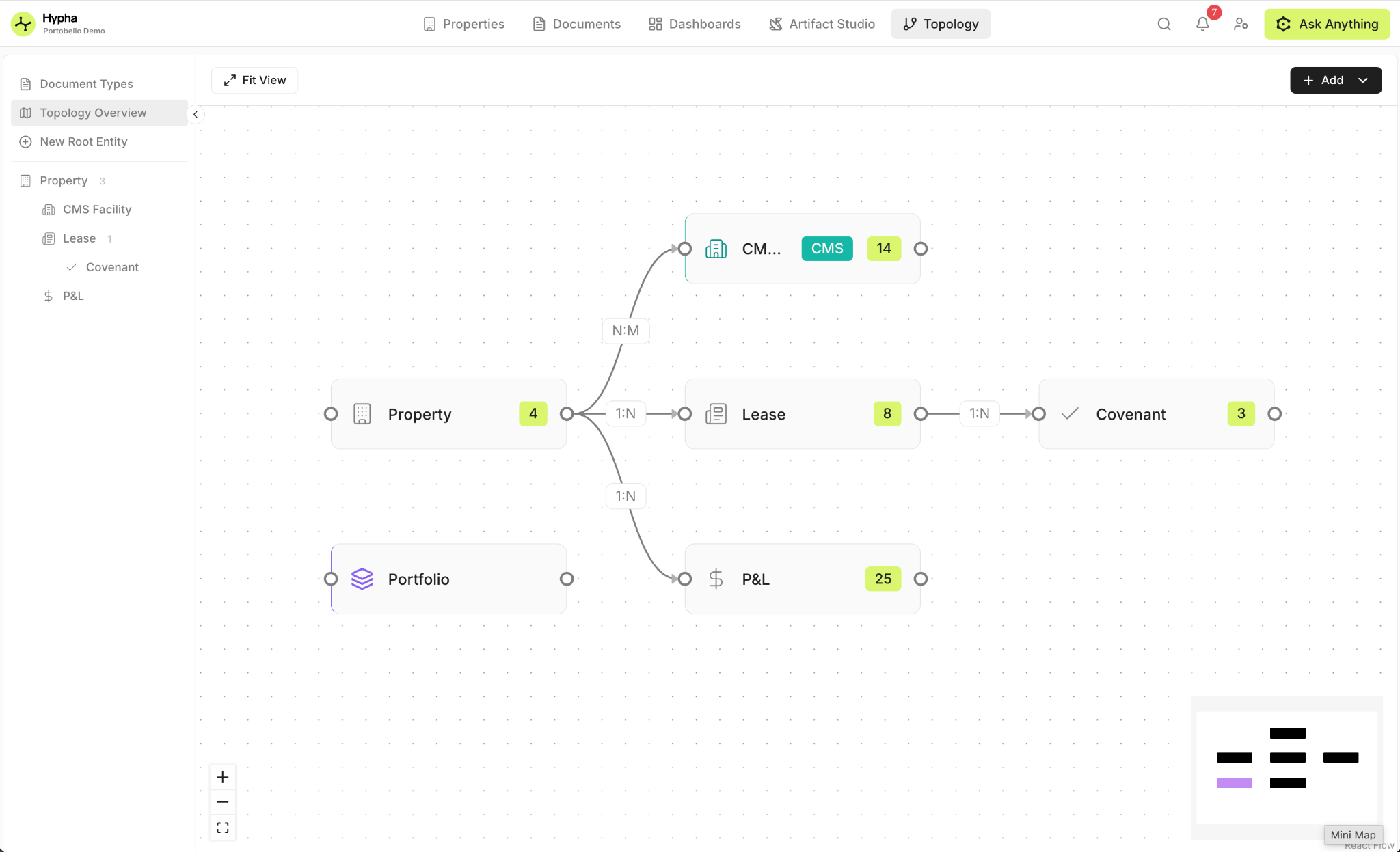
### Layer 3: Human Judgment & Continuous Mapping Refinement
Once auto-mapping is done, Hypha notifies the analyst to come in and approve the spread. We structure this review around three steps:
1. **Restatement check.** Hypha surfaces deltas against historical filings so the analyst can distinguish a genuine restatement from a re-interpretation of the same source.
2. **Anomaly detection.** Confirming that totals reconcile and subtotals tie to their line items.
3. **Manual adjustments.** Human-judgment calls that don't belong in the firm's standing logic, such as a non-recurring legal settlement, or a sponsor-specific quirk that hasn't surfaced before.
Across all three, Hypha surfaces what the analyst needs to see and gets out of the way.
This is also where the system's learning extends beyond mapping. When a manual adjustment isn't actually one-off — when it reflects a firm policy the system hasn't captured yet — the Hypha agent picks up on the pattern and promotes it into a standing rule that applies automatically on the next spread. Over time, fewer adjustments need to be made by hand, because more of them have already been encoded as firm logic.


### The Output
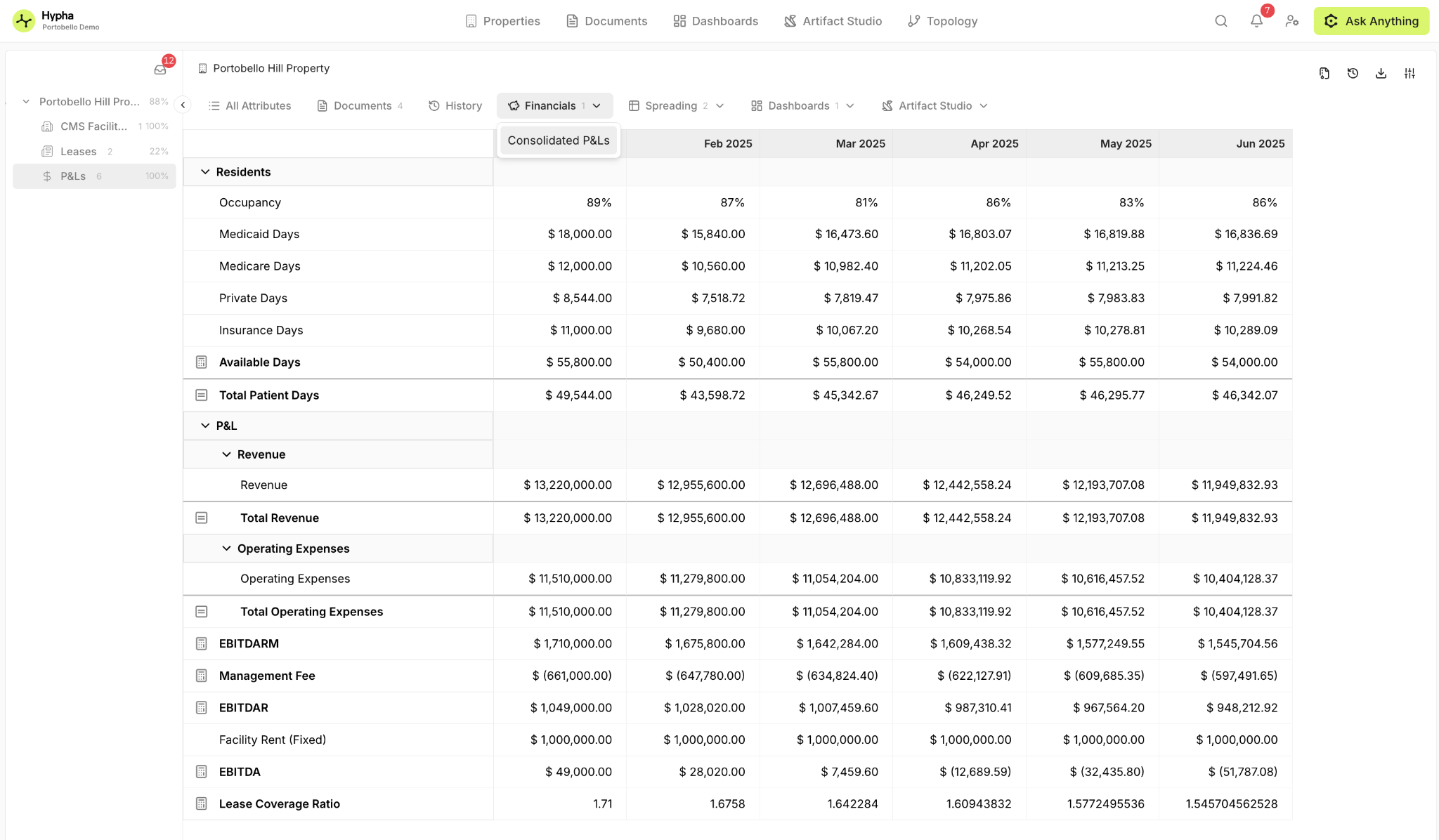
All financials are spread in the same environment, so once the process is done, the analyst gets a consolidated view in one place. The sheet is accessible and downloadable at any time.
## The new standard for financial spreading
Spreading financials manually no longer has to be the norm. What replaces it will be systems where the analyst's judgment is the anchor, and the document mechanics are handled by agents operating against an auditable, versioned record of the firm's own decisions.
Here's what that looks like in practice for CRE teams using Hypha:
- **One environment for the spread and the source.** Your team can move between the spread and the underlying workbook without leaving Hypha. Hypha bridges that navigation gap between the "too general" and the "too detailed."
- **A system that gets sharper the more financials spread.** Your firm builds a shared reservoir of mapping logic that improves over time. Every adjustment an analyst makes becomes firm-level memory the agent applies to the next document automatically.
- **An audit trail that holds up to scrutiny.** You can trace any cell in the spread back through its mapping decision to the specific cell in the source it came from. No more compliance headaches.
## What's next: Pro Forma
Spreading is the foundation. What we are building towards is a future where every forward-looking decision your firm makes is grounded in a single, reliable source of truth derived from every asset you've ever touched.
Transforming historical financial data into a Pro Forma Model is the next step that unlocks that: clean, normalized data feeding directly into forward-looking analysis that your business can act on as is.
Book a demo with us
---
# Design Principles for Human-First AI
Source: https://www.hypha.co/blog/design-principles-human-first-ai
Published: 2026-03-12
Author: Kashish Kalra, Hypha
In high-stakes decisions, trust isn't about blind acceptance — it's about clarity, traceability, and keeping humans in control.
Hypha emerged from a simple observation: in capital markets, billion-dollar decisions are made using information scattered across hundreds of documents. The work is high-stakes, detail-intensive, and fundamentally human. No one wants AI making those calls for them. At the same time, everyone wants help finding, organizing, and making sense of the information they need.
That's the tension we're designing for. Not "how do we automate decisions?" but "how do we give people the information and confidence they need to make better ones?"
Traditional AI design hides complexity. Show the answer, skip the work. In high-stakes environments, that black box creates more anxiety than clarity. Our design principles start somewhere else: what if we designed systems where it's easier to verify than to blindly trust?
If Hypha tells you something, you should be able to see where it came from — not buried in a footnote but right there in the interface. Source documents should be accessible. Calculations should reveal their methodology. Updates should show their provenance.
We have been adamant about this from Day One. Transparency isn't optional. We design assuming you'll want to verify things. Not because we expect you to check everything but because you should never have to wonder.
Hypha's edge is that it surfaces patterns humans can't see. But that only matters if you can trace how it got there. This changes how we think about interface design. Provenance isn't an afterthought — it's built into every interaction. Every data point carries its source. The system distinguishes between what it generated and what a human entered. Audit trails aren't hidden in settings menus.
There's well-documented research on how interface design shapes decision-making. When one option requires less effort than another, people default to it — even when they'd prefer the alternative. This isn't laziness. It's how we make decisions under cognitive load.
Most AI interfaces exploit this by making acceptance frictionless. Rejection requires more justification. Partial edits mean throwing out the whole output and starting over. The cumulative effect: people accept AI outputs they don't fully trust because disagreeing feels like more work.
We design for the opposite outcome. When someone has reservations about what the system generated, following that instinct should feel natural. The interface shouldn't create friction around human judgment but instead treat it as the most valuable input in the system.
This matters in high-stakes decisions because the cost of going along with something you don't trust isn't just a bad outcome but the erosion of your role in the process. Over time, if overriding the system feels harder than accepting it, you either stop being a decision-maker or stop using the system. Neither is an outcome that's ideal.
Not all information has the same quality, and we shouldn't pretend it does.
Verified data extracted from documents gets presented plainly. Calculations derived from that data are marked as such — you can see the methodology if you want. Predictions or risk assessments are explicit about confidence levels and show ranges instead of precise numbers that imply false certainty.
The interface makes these distinctions clear. You can take a warning seriously without trusting a level of precision the system can't actually deliver.
## What this means in practice here at Hypha
Every design decision comes back to one question: What would make you trust this enough to stake your reputation on it?
Because that's the reality in capital markets. Trust is clarity about when to rely on the output, when to interrogate it, and when to step in.
Human-First, AI-Native means the system works with you, not around you. It does the heavy lifting — organizing, calculating, and flagging — but you stay in control. Verification is easier than blind acceptance. The AI informs your decision. It doesn't make it for you.
The result isn't always the fastest interface, but it's the most reliable. The feeling that you understand what you're looking at, where it came from, and whether you can trust it.
In high-stakes decisions, that's what makes all the difference.
---
# How We 10x'd Engineering Velocity as an AI-First Startup
Source: https://www.hypha.co/blog/10x-engineering-velocity
Published: 2026-02-25
Author: Spencer Fink, Hypha
The engineering teams that move fastest aren't just writing code quickly. They're compounding small gains forward while eliminating the things that pull them backward.
The engineering teams that move fastest aren't just writing code quickly. They're compounding small gains in forward speed while systematically eliminating the things that pull them backward. Stack enough of those gains together and you get something that looks, from the outside, like a team moving impossibly fast. From the inside, it just feels like nothing is in the way.
## Hire AI-augmented engineers, not vibe coders
We got here by doing two things simultaneously: hiring engineers who know how to wield AI as a tool, and rebuilding the infrastructure underneath them so the system could keep up. (More on what that hiring looks like in [We're Not Hiring Software Engineers Anymore](/blog/not-hiring-engineers).)
Vibe coders prompt their way to working prototypes without understanding what the code actually does. They're productive in demos and dangerous in production. We don't hire them. Engineers who thrive at Hypha have deep knowledge of systems design, database internals, concurrency, and failure modes. They also know how to leverage AI to draft implementations, generate tests, and explore unfamiliar codebases, then apply their judgment to evaluate, refine, and ship the result. AI accelerates them. Their fundamentals are what make that acceleration safe.
## Compound speed forward, eliminate steps backward
When AI accelerates the coding, everything else becomes the bottleneck. With that in mind, we rebuilt our entire pipeline.
- **Bulletproof deployments.** We split our single-job deploy into three sequential stages where a failure at any stage safely halts the pipeline with no partial state, and every stage is idempotent so re-running a failed deploy is a one-click operation, not a recovery effort. Deploys went from "everyone holds their breath" to "nobody notices."
- **Automated CI gates.** Immutable migrations with schema drift detection, blocking type checks that prevent type errors from ever reaching production, dead code detection that keeps the codebase clean so AI agents don't learn from misleading context, and a dramatically expanded test suite that catches regressions before reviewers ever see the PR.
- **Stacked PRs.** Aim small, miss small. We adopted Graphite so engineers break work into small, atomic changes that build on each other, each one 50–200 lines and reviewable in under five minutes. Review cycles dropped from days to hours, and review quality went up because reviewers could actually hold the entire change in their head. We even wrote a Claude Code skill that takes a messy branch and splits it into a clean stack automatically.
- **Planning PRs.** The first PR in every stack is a markdown file that walks through the architectural approach. The team aligns on design asynchronously before a single line of implementation ships, eliminating synchronous design reviews entirely.
- **Observability as decision-making.** We rebuilt logging around Axiom with scoped, semantic loggers so we can see which surfaces users actually engage with, where pipelines slow down, and where to invest next. Every infrastructure investment is informed by data, not intuition.
## Why we care this much about velocity
Teams make high-stakes decisions on top of messy, unstructured data: loan agreements, rent rolls, financials, and appraisals, all trapped in PDFs and spreadsheets. Parsing wildly inconsistent documents across dozens of formats. Building extraction pipelines fast enough for deal flow and accurate enough that institutions trust the output. AI systems that reason over thousands of pages with citations. These are the problems we solve every day.
Hypha replaces the status quo of offshore data entry and stale systems of record. We extract structured data from any document format and link every value back to its source. But extraction is just the foundation. We're building covenant monitoring, portfolio analytics, investor reporting, and eventually the infrastructure that lets firms run their entire operation on structured, auditable data.
We're a small team where every engineer has outsized ownership because they have to. The [principles behind how we build](/blog/human-first-depth-momentum)—human-first, depth over breadth, momentum over perfection—are what make this work. If that resonates, [we're hiring](/careers).
---
# We're Not Hiring Software Engineers Anymore
Source: https://www.hypha.co/blog/not-hiring-engineers
Published: 2025-01-29
Author: Austin Sheppard, Hypha
AI is turning programming into a commodity skill. The job isn't disappearing — it's becoming something else entirely.
When's the last time you hired a typist?
 {/* prettier-ignore */}
Source: The Rise and Fall of the Female Typist, The CGO
In the 1950s, typing was a profession. Companies employed entire pools of specialists who trained for years to hit 80+ words per minute. Then word processors happened—and typists didn't disappear because typing stopped mattering. They disappeared because _everyone_ learned to type.
The skill became table stakes. The same thing is happening to programming.
## Programming is no longer a job. It's a skill.
Two years from now, five years from now—the timeline doesn't matter as much as the direction. Writing code is not going to be a job. It's going to be a skill embedded in dozens of other jobs, the way typing is today.
When typing became universal, it didn't create a world of professional typists. It created a world where typing was _assumed_—and the people who refused to learn got left behind. Programming is headed to the same place. Not because everyone will become a software engineer. But because everyone will use code the way they use a keyboard.
[Boris Cherny](https://www.lennysnewsletter.com/p/head-of-claude-code-what-happens), who leads Claude Code at Anthropic, put it this way: before the printing press, scribes were about 1% of the population. The printing press made 70% of the world literate within 200 years. AI coding tools are doing the same thing for programming—but in years, not centuries.
The numbers already reflect this. [73% of engineering teams](https://survey.stackoverflow.co/2025/ai) use AI coding tools daily in 2026, up from 18% in 2024. [MIT Technology Review](https://www.technologyreview.com/2026/01/12/1130027/generative-coding-ai-software-2026-breakthrough-technology/) named generative coding one of its 10 Breakthrough Technologies of 2026. "Vibe coding" was Collins Dictionary's Word of the Year in 2025. [Replit's AI Agent](https://www.semafor.com/article/01/15/2025/replit-ceo-on-ai-breakthroughs-we-dont-care-about-professional-coders-anymore) has produced over 2 million apps in six months—without users writing a single line of code.
This isn't a prediction. It's already happening.
## What the job is becoming
For most of my career, the software engineering job was clear: know a language deeply, translate requirements into code, debug when things break, ship features. I got my first break when React was new—I'd built side projects with it, and being "cracked at React" _was a job._
That job still exists in name. But at Hypha, AI now generates 80–99% of our code. Actual features, actual systems. Our team spends less time writing code and more time reviewing it, directing it, shaping it. (We wrote about the infrastructure that makes this possible in [How We 10x'd Engineering Velocity](/blog/10x-engineering-velocity).)
Technical fluency hasn't disappeared. It's just one skill among ten:
**Problem definition.** What to build and why. AI can't sit in a customer call and hear frustration. Can't synthesize five conflicting requests into one insight.
**Customer discovery.** Talking to users. Asking good questions. Extracting signal from noise.
**Systems thinking.** How pieces connect. Second-order effects. AI solves what's in front of it. Humans see the whole board.
**Design sensibility.** Taste. Knowing when something feels right. AI generates ten options—someone has to know which one is good.
**Clear communication.** Specs. Prompts. Decisions. When you collaborate with systems that interpret words literally, precision matters.
**Agent orchestration.** Directing AI effectively. When to give autonomy. When to intervene. Management, except your reports run on GPUs.
**Quality judgment.** AI produces fast. Knowing whether output is good—that's the bottleneck.
**Technical fluency.** Reading code. Debugging. Understanding tradeoffs. This used to be the entire job. Now it's one of ten.
**Prioritization.** When building gets faster, deciding what to build becomes the constraint.
**Domain expertise.** Deep knowledge of your problem space. AI doesn't know what matters to your users.
## Everyone writes code now
At Hypha, we're not just asking more of our engineers. We're watching code spread across the entire organization.
**Our designers write code.** Not because we made them learn React. Because Claude Code lets them work directly in our actual codebase—faster than they could in Figma. They make real changes to see what they look like in real time: tweaking a button component, adjusting spacing, iterating on color. They build prototypes with mock data—"here's what a Hypha bar chart should look like"—getting the full benefit of our component library and agentic context on our codebase. And our website is just a Next.js app—our designers commit directly to it, their changes go through PR review like any other code. They're literally coding.
**Our PMs write code.** They use Claude to rapidly prototype ideas and build proof-of-concepts with mocked data. The goal is communication—when a PM can show a working rough version instead of describing one in a doc, the conversation with engineering is completely different. They also rubber duck with Claude instead of pulling an engineer off their work, asking questions about the codebase, understanding how things connect, finding where the limitations are. Their PRDs are dramatically better because they can _see_ what they're specifying before they specify it.
**Our go-to-market team writes code.** They use Claude to build customer decks, investor presentations, and internal tools. Six months ago, these would have been a ticket to engineering or a request to design. Now they just build them.
None of these people would call themselves software engineers. They're designers, PMs, and marketers who happen to use code as one tool among many. Just like nobody calls themselves a "typist" anymore—they're all professionals who happen to type.
## Same skill, different focus
Everyone is writing code, but they're not all doing the same thing with it. The skill is universal. The application is specialized.
**Engineers** focus on what they've always focused on—but at a higher level. Scale. Edge cases. Reliability. Observability. Security. Systems architecture. The code itself is increasingly AI-generated, but the judgment about _what_ that code needs to do, how it needs to behave under load, how it fails gracefully—that's engineering. The job isn't writing code. It's ensuring the system works.
**Designers** focus on what code _looks and feels_ like. They prototype in the real medium. They iterate on interactions, spacing, motion—working directly in the codebase instead of an abstraction layer removed from it. Their output is a working starting point, ready for an engineer to harden.
**PMs** focus on what's _worth building_. They prototype to validate. They build to communicate. They use code to rapidly test assumptions, to iterate on ideas in hours instead of sprints. The code is a thinking tool.
**Go-to-market teams** focus on what _moves the business_. Custom presentations, internal dashboards, workflow automations. Code as leverage for their actual job.
The skill is the same. The intent is different. And that's exactly how typing works today—an accountant and a novelist both type, but they're doing fundamentally different things.
## The lines are already blurred
This isn't just us. [Anthropic's own product lawyer](https://claude.com/blog/how-anthropic-uses-claude-legal) built an AI bot with no coding background. Non-technical Y Combinator founders are building functional prototypes with vibe coding tools. [LinkedIn launched a "Full-Stack Builder" program](https://sfstandard.com/2026/03/05/engineer-2025-ai-land-everyone-s-builder-now/) that trains employees across all roles—not just engineering—to build with code.
[Satya Nadella](https://www.cnbc.com/2025/04/29/satya-nadella-says-as-much-as-30percent-of-microsoft-code-is-written-by-ai.html) said it directly: "Now anyone can be a software developer." 30% of Microsoft's code is AI-written. At Google, it's over 30%. At Anthropic, it's 70–90%.
Jensen Huang told people to stop learning to code in the traditional sense. Focus on domain expertise—biology, education, operations—and let AI handle the implementation. Dario Amodei, CEO of Anthropic, said some of his engineering leads don't write any code anymore.
The direction is unmistakable. The specialized skill is becoming ambient infrastructure.
## What this means for you
If you're an engineer: your value isn't your ability to write code. It's your ability to _think in systems_. To understand failure modes, to architect for scale, to make judgment calls that AI can't. The engineers who thrive won't be the fastest coders. They'll be the ones who understand what's worth building—and how to build it right.
If you're a designer: code is your new medium, an extension of design thinking. You can now prototype at the speed of thought, in the actual material your work ships in. The designers who thrive will be the ones who stop handing off static mockups and start building.
If you're a PM: code is your thinking tool. Build rough versions. Understand constraints firsthand. Write better specs because you've already felt where things break. The PMs who thrive will be the ones who show, not tell.
If you're in any other role: look at the repetitive, manual parts of your job. The spreadsheet gymnastics. The ticket-and-wait workflow. The things you've always wished you could just _build_. You can now. The people who thrive will be the ones who reach for code as naturally as they reach for a keyboard.
The typists who adapted in the 1960s became knowledge workers with broader scope. They didn't lose their typing skills—they added new ones on top. Their careers expanded.
The same opportunity is here now. Programming isn't disappearing. It's dissolving into everything. Your value—as an engineer, designer, PM, or anything else—hinges on whether you're willing to reinvent how you work.
---
_If you're navigating this shift too, I'd like to hear how you're thinking about it. [Reach out](/contact). And if you want to understand the principles behind how we build, read [Human-first, Depth, and Momentum](/blog/human-first-depth-momentum)._
---
# Human-first, Depth, and Momentum
Source: https://www.hypha.co/blog/human-first-depth-momentum
Published: 2024-11-12
Author: Peter Wang, Hypha
The three operating principles that guide how we build Hypha.
Earlier this year, Simcha and I joined forces to build Hypha. We've both weathered two financial crises and two major tech cycles, just from very different seats. Simcha built a successful family office at the intersection of private equity, real estate, and venture. I've spent two decades building venture-backed startups with four successful exits.
Different paths, but we both want to build something meaningful, impactful, and durable.
Here are Hypha's three operating principles:
- Human-first > Tech-first
- Depth > Breadth
- Momentum > Perfection
## Human-first > Tech-first
Most AI teams start with the model and look for problems to solve. We do the opposite.
We start with people. We bring builders and domain experts to the same table. We embedded ourselves in our design partners' offices to observe their workflows, friction points, and decision-making—then built a cohesive platform around what we learned.
We measure success not just by efficiency metrics like time saved, but by better decisions made faster and more headspace for high-leverage work.
This human-first approach extends to everything—including how we talk. While other platforms describe their onboarding as "Data Migration and Integration," we call it BYOD: Bring Your Own Data. Same idea, less corporate speak.
## Depth > Breadth
Most AI companies build horizontal tools with little moat against LLMs or narrow point solutions. We're doing the opposite—we're going all the way down to the root and building our way back up.
The root of reactive culture in asset management is fragmented data. Documents buried in emails, multiple versions, hundreds of pages to parse for a single data point. I call it the "Where's Waldo?" problem.
We're solving the hard problem others avoid: turning fragmented, unstructured documents into a trusted single source of truth as the first building block, then layering intelligence and execution on top.
When GitHub launched in 2008, it became the backbone for how developers collaborate. We're building the same for all stakeholders in asset management—a platform so integral to how deals get done that it becomes the standard.
## Momentum > Perfection
Momentum isn't just speed—it's progress toward a clear direction. And speed with focus compounds.
When builders optimize for momentum, there's a natural tension between chaos and control. Too much chaos, you lose direction and risk bloat. Too much control, you stifle innovation and first-principles thinking.
I monitor what I call the "chaos-to-control ratio"—maintaining just enough chaos to move fast and solve problems in unexpected ways, with just enough control to stay pointed in the right direction. Every standup, product discussion, client conversation recalibrates our roadmap, our hiring, our next move. (See how this plays out in practice in [How We 10x'd Engineering Velocity](/blog/10x-engineering-velocity).)
The legendary coach Frank Dick once said, "Winning is being better today than you were yesterday, every day." That's momentum—not perfection on day one, but directional progress compounding over time.
---
These three principles reinforce each other in everything we build at Hypha.
If you're dealing with fragmented data and want to see what a human-first approach looks like in practice, [request a demo](/demo) or [get in touch](/contact).
---
# Deal Analyzer — frequently asked questions
Source: https://www.hypha.co/solutions/deal-analyzer
## How do we know the numbers are right?
Every value Hypha extracts carries a citation back to the exact language in the source document. Verification rows check spread totals against the raw document and flag mismatches before they reach the model. Line items Hypha has not seen before get a needs-review tag until a person confirms them. Nothing flows downstream unverified.
## Our team already uses Claude or ChatGPT. Why do we need this?
General-purpose AI produces one-off answers. Deal Analyzer produces repeatable, structured output. Extractions follow the same rules on every deal, mappings persist period over period, and every number traces from source document to model to memo. The difference shows up on the tenth deal, not the first.
## What asset types does Deal Analyzer support?
Deal Analyzer is configured to the asset classes on your book. Each asset class gets its own chart of accounts, underwriting model, and assumptions, so a self-storage deal and a multifamily deal spread differently from day one.
## Where does our data live?
Hypha supports flexible deployment. Data can sit in Hypha's SOC 2 compliant environment or in a dedicated database on your infrastructure, depending on your security requirements.
## How is sensitive borrower information protected?
Hypha is SOC 2 compliant. Deployments can include a dedicated virtual private cloud and redaction workflows that strip sensitive fields like Social Security numbers before documents enter the platform.
## Can Hypha spread tax returns?
Yes. Hypha spreads any financial document into the chart of accounts it belongs to. Personal and entity tax returns map to your global analysis model. Property financials map to your property model. Each document type routes to the right spread automatically.
## How does Hypha handle documents with amendments?
Extraction rules and document versioning resolve conflicts across versions. When a lease or loan agreement has been amended, Hypha pulls the most recent term from the latest amendment and cites where every prior version stated it.
## What if a document never states the term directly?
Hypha reads for meaning, not keywords. A lease that never says triple net still gets classified by its reimbursement provisions. Every extracted value carries a citation back to the exact language in the source document.
## Do we have to change our models or templates?
No. Your existing Excel models, memo formats, and chart of accounts embed into Hypha during implementation. Hypha fits your workflow, not the other way around.
## Can we start with Deal Analyzer and expand later?
Yes. Deal Analyzer runs on its own. Most lenders start with one workflow, prove it on live deals, then add covenant compliance or portfolio monitoring when ready. Everything runs on the same data structure, so expansion means turning on a module, not re-implementing.
---
# About Hypha
Source: https://www.hypha.co/about
## We’re solving the hardest problems in asset management
Hypha is the connected operating layer for investment workflows. The investment ecosystem runs on fragmented, unstructured documents: credit memos, operating statements, loan agreements, appraisals. The gap between that data and a decision only keeps widening. Hypha reads and structures those documents, turning static files into intelligence that stays current, so investors, lenders, operators, and advisors can work from one source of truth.
Hypha runs deepest today in commercial real estate and private credit, built alongside industry operators who’ve closed billions. Lenders and asset managers use Hypha to underwrite faster, monitor covenants as they change, and track portfolio performance across the entire book.
## Built by people who’ve lived it
### Hypha leadership
#### Peter Wang — Co-Founder, CEO
Tech executive and investor with 20+ years scaling businesses across fintech, ad tech, media, commerce, and health. Six VC-backed startups, three acquisitions (Salesforce, Spotify, Vice), and one IPO (BuzzFeed).
LinkedIn: https://www.linkedin.com/in/yuchunwang/
#### Simcha Hyman — Co-Founder & Chief Helper
One of the largest private owners of skilled nursing facilities in the U.S. Built Hypha to solve the document chaos he lived every day managing a multi-billion dollar portfolio.
LinkedIn: https://www.linkedin.com/in/simcha-hyman-b530a52b/
#### Ali Jawin — Chief Revenue Officer
Chief Revenue Officer leading sales, marketing, and revenue operations at Hypha as one GTM engine. Two-time CMO who created a new category at Pontera, pioneered AI strategy at Outreach, and made Pavilion's 50 CMOs to Watch.
LinkedIn: https://www.linkedin.com/in/alijawin/
#### Austin Sheppard — Head of Engineering
Engineering leader and exited founder with a decade of experience building 0→1 products across fintech, AI, and SaaS at State Street, nference, Toast, and Hebbia.
LinkedIn: https://www.linkedin.com/in/austin-sheppard/
### Board and advisory members
#### Alan Litt — Board Member
30+ years as a developer, owner/operator, and lender in multifamily and seniors housing. Co-Founder of Monticello AM and EVP at BlackRock Monticello Debt REIT.
LinkedIn: https://www.linkedin.com/in/alan-litt-330880126/
#### Erik Lindenauer — Advisor
30+ years in mortgage and investment banking, specializing in healthcare lending, multifamily housing, and FHA/FNMA-insured loans. President of Healthcare and FHA Lending at NewPoint Real Estate Capital.
#### Avery Eisenreich — Board Member
Founder & CEO of Yakar Partners, a multi-strategy family office.
#### Daniel Posy — Advisor
Daniel Posy serves as Vice Chairman in JLL’s New York office where he is a leader in the tenant representation group. Daniel has worked with a broad range of industries, focusing on multi-market corporate clients. He has also developed an expertise in representing boutique financial services firms by leveraging critical market knowledge to empower tenants.
LinkedIn: https://www.linkedin.com/in/daniel-posy-55019b13
#### Avi Mayer — Advisor
Co-founder of Afton Properties.
#### Udi Milo — Advisor
Partner PM at Microsoft, leading the AI Foundry developer experience and growth team. Previously VP of Product & Growth at Tinder and Head of Product for driver growth at Lyft, across its run from $5B to $15B in valuation. Earlier product roles at Pinterest and LinkedIn, and co-founder and CEO of Fibo.
LinkedIn: https://www.linkedin.com/in/udimilo/
## Our principles
Building for a complex industry requires trade-offs. These principles guide every decision we make. They are a commitment to our customers, a marker of our ambition, and the values that unify everyone on the Hypha team.
### Human-first > tech-first
Most AI teams start with the model and look for problems to solve. We do the opposite.
We start with people, bringing builders and domain experts to the same table. We embedded ourselves in our design partners' offices to observe their workflows, friction points, and decision-making—then built a cohesive platform around what we learned.
We measure success not just by efficiency metrics like time saved, but by better decisions made faster and more headspace for high-leverage work.
### Depth > breadth
The root of reactive culture in asset management is fragmented data. We're solving the hard problem others avoid: turning fragmented, unstructured documents into a trusted single source of truth as the first building block, then layering intelligence and execution on top.
When GitHub launched in 2008, it became the backbone for how developers collaborate. We're building the same for all stakeholders in asset management—a platform so integral to how deals get done that it becomes the standard.
### Momentum > perfection
Momentum is progress toward a clear direction. And speed with focus compounds.
When builders optimize for momentum, there's a natural tension between chaos and control. Too much chaos, you lose direction and risk bloat. Too much control, you stifle innovation and first-principles thinking.
Our sweet spot is to maintain just enough chaos to move fast and solve problems in unexpected ways, and just enough control to stay pointed in the right direction.